

Serenity is the balance between good and bad, life and death, horrors and pleasures. Life is, as it were, defined by death. If there wasn't death of things, then there wouldn't be any life to celebrate.
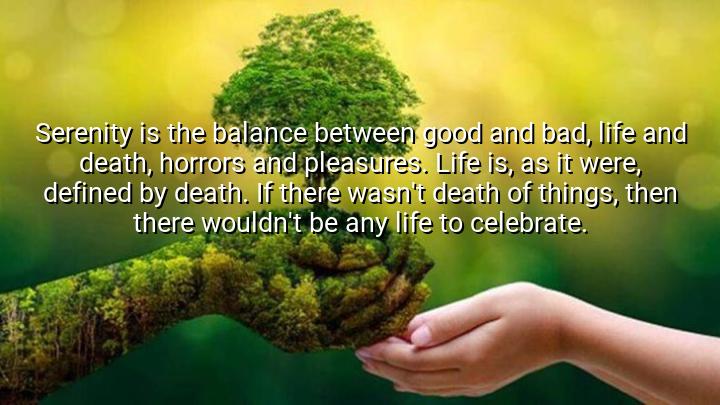




Norman Davies’ quote, "Serenity is the balance between good and bad, life and death, horrors and pleasures," reflects the idea that peace or serenity arises from acknowledging and embracing the dualities inherent in life. Davies suggests that true balance is found not in the absence of suffering or conflict but in the ability to live with both the positive and negative aspects of existence. Serenity is not the absence of pain or struggle but the acceptance of these elements as part of the human experience, allowing individuals to find equilibrium amidst them.
The second part of the quote, "Life is, as it were, defined by death. If there wasn't death of things, then there wouldn't be any life to celebrate," expands on the idea of duality, emphasizing that death is not just a natural end but also a necessary component of life. Without death, there would be no change or renewal, and life would lose its meaning. Just as the end of one cycle gives birth to another, death serves as a defining force in shaping the vitality and impermanence of existence.
Davies, a historian and scholar, often explores the interplay of contrasting forces in history and human experience. His perspective aligns with broader philosophical ideas that emphasize the importance of accepting both life’s joys and sorrows. Through this, he highlights the cyclical nature of existence, where loss and renewal are inextricably linked. The quote encourages an understanding that life’s meaning comes not only from its pleasures but from its transient nature and inevitable end.
The origin of this quote can be traced to Davies' reflections on history, human existence, and the importance of balance in understanding the human condition. As someone who examines the intersections of life, death, and history, Davies reminds us that serenity is achieved not by avoiding the hard parts of life but by accepting them as integral to the broader journey. The idea that death defines life underscores the necessity of accepting mortality to appreciate the vibrancy and impermanence of existence.

AAdministratorAdministrator
Welcome, honored guests. Please leave a comment, we will respond soon