

Semiotics is a general theory of all existing languages... all forms of communication - visual, tactile, and so on... There is general semiotics, which is a philosophical approach to this field, and then there are many specific semiotics.
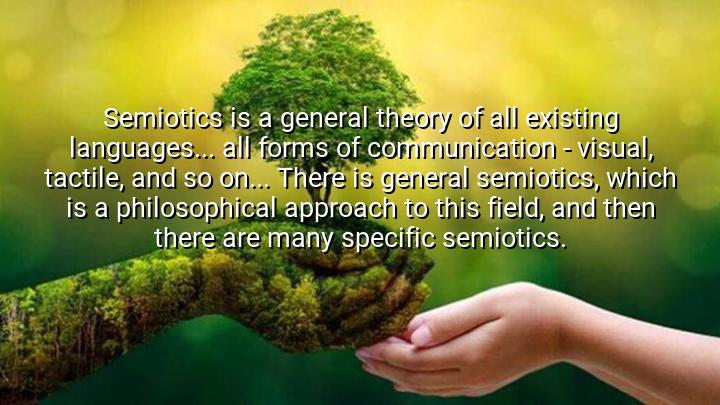




In this quote, Umberto Eco explains the concept of semiotics, describing it as a general theory that encompasses all forms of communication across different mediums. He highlights that semiotics is not limited to verbal or written languages but includes visual, tactile, and other forms of expression. Eco’s point is that semiotics studies how meaning is created and communicated through a variety of symbols, signs, and systems, offering a broader understanding of how humans interact with the world and each other.
The origin of this quote is rooted in Eco’s work as a philosopher, semiotician, and author, where he extensively explored the field of semiotics, particularly in his books such as A Theory of Semiotics. Eco was instrumental in establishing semiotics as a formal discipline that extends beyond traditional linguistics, looking at how signs function in various contexts, from literature to visual art to advertising. His insights into semiotics have influenced fields such as communication, cultural studies, and media theory.
Eco differentiates between general semiotics, which is a philosophical and theoretical approach to understanding all systems of signs, and specific semiotics, which focuses on particular forms of communication, such as linguistic semiotics or visual semiotics. By doing this, he shows how semiotics can be applied to a wide range of disciplines and contexts, each with its own system of signs and rules for interpreting meaning.
Ultimately, Eco’s quote underscores the breadth and complexity of semiotics as a field of study. It’s not limited to any single mode of communication but rather examines the ways in which all forms of signs and symbols create meaning. Eco’s work on semiotics has helped shape our understanding of communication as a multi-faceted and deeply ingrained part of human interaction, extending beyond language to include visual and sensory experiences.

AAdministratorAdministrator
Welcome, honored guests. Please leave a comment, we will respond soon