

Scientific discovery and scientific knowledge have been achieved only by those who have gone in pursuit of it without any practical purpose whatsoever in view.
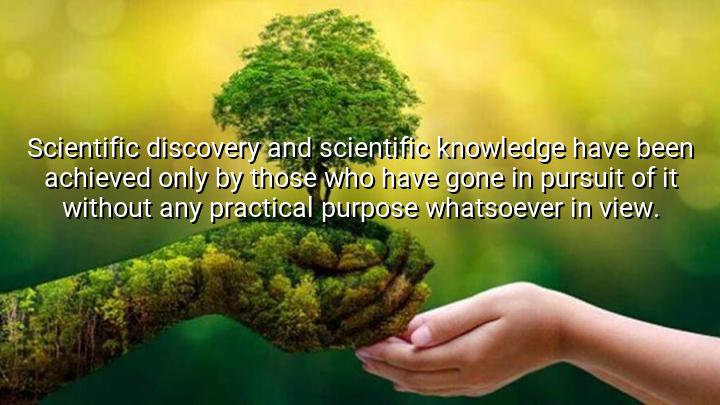




The quote by Max Planck, “Scientific discovery and scientific knowledge have been achieved only by those who have gone in pursuit of it without any practical purpose whatsoever in view,” emphasizes the role of curiosity and pure inquiry in advancing science. Planck suggests that the most profound discoveries often emerge not from utilitarian goals or immediate applications but from the relentless pursuit of understanding for its own sake. True knowledge grows when researchers are motivated by curiosity rather than solely by practical or financial incentives.
Max Planck, a German physicist and pioneer of quantum theory, profoundly influenced modern physics and scientific philosophy. In this quote, he reflects on the nature of innovation and intellectual exploration, highlighting that many breakthroughs occur when scientists focus on understanding the laws of nature, rather than seeking immediate practical outcomes. His insight underscores the importance of fostering intellectual freedom and supporting fundamental research.
The origin of this quote lies in Planck’s reflections on the history and philosophy of science. He observed that many revolutionary advances—from the discovery of quantum phenomena to fundamental physics principles—were achieved by individuals motivated by pure curiosity and a desire to understand the world. Practical applications often emerged only after the theoretical foundations had been established.
Ultimately, Planck’s insight reminds us that the pursuit of scientific knowledge is driven by exploration and intellectual passion. The quote emphasizes that innovation and discovery flourish when researchers are free to follow their curiosity, illustrating that the quest for understanding itself is a powerful and necessary force behind scientific progress.

AAdministratorAdministrator
Welcome, honored guests. Please leave a comment, we will respond soon