

It is not the possession of truth, but the success which attends the seeking after it, that enriches the seeker and brings happiness to him.
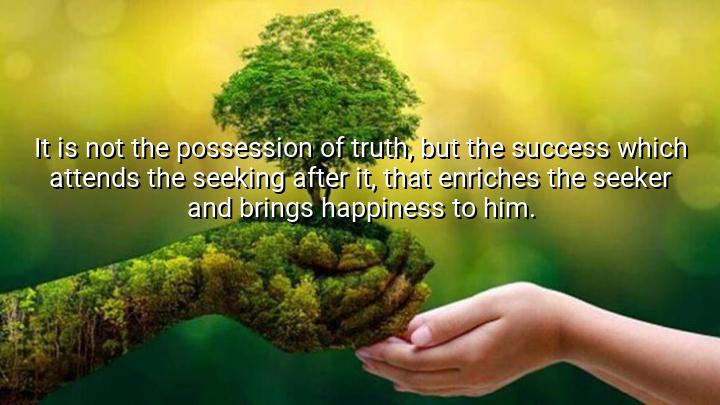




The quote by Max Planck, "It is not the possession of truth, but the success which attends the seeking after it, that enriches the seeker and brings happiness to him," emphasizes the value of the journey of discovery rather than the end result. Planck, a German physicist and the founder of quantum theory, suggests that the process of searching for truth—whether in science, philosophy, or personal growth—is more fulfilling and rewarding than simply obtaining the truth itself. The pursuit itself enriches the individual, providing growth, insight, and satisfaction.
Planck’s perspective shifts the focus from the possession of knowledge to the experience of seeking it. Truth, in this sense, is not an absolute or final destination, but rather an ongoing pursuit. The challenges, curiosity, and dedication involved in the search for truth are what shape and transform a person, providing happiness and fulfillment. This view aligns with Planck's own experiences in the scientific community, where much of his work revolved around continual inquiry and the constant reevaluation of scientific principles.
The quote also suggests that success is not measured by the accumulation of facts or certainties but by the commitment to the search itself. It highlights that personal growth and happiness come not from definitive answers, but from the intellectual and emotional rewards that come with actively seeking to understand the world. The act of questioning, exploring, and engaging with complex ideas can bring more happiness than simply knowing the answer.
Ultimately, Planck’s words encourage a shift in mindset: rather than focusing solely on achieving truth, one should find joy and enrichment in the pursuit. This perspective invites a deeper appreciation for the process of exploration and discovery, suggesting that it is in the searching, learning, and growing that we find true satisfaction and happiness.

AAdministratorAdministrator
Welcome, honored guests. Please leave a comment, we will respond soon