

Science is a differential equation. Religion is a boundary condition.
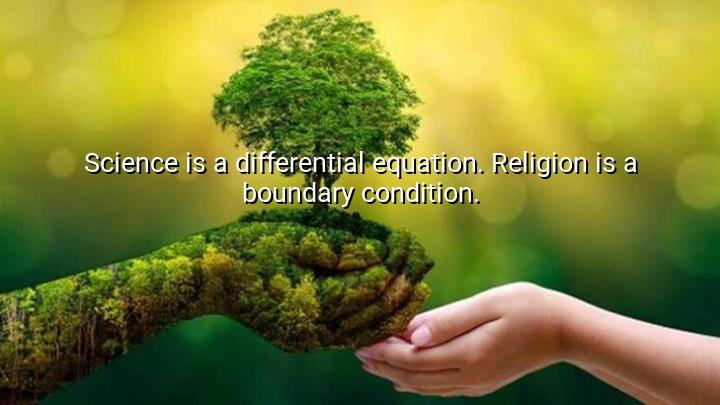




Alan Turing’s quote, "Science is a differential equation. Religion is a boundary condition," presents a unique perspective on the relationship between science and religion, using concepts from mathematics and physics to illustrate his point. Turing, a brilliant mathematician and the father of modern computer science, is known for his work in logic, computation, and artificial intelligence. In this quote, he likens science to a differential equation, which in mathematics is an equation that describes how quantities change over time or space. This metaphor suggests that science is constantly evolving, driven by data, experimentation, and progress—it is about understanding and solving the world’s complexities.
The second part of the quote, "religion is a boundary condition," introduces the idea that religion serves as a limiting factor or a framework that helps guide and constrain human understanding. In the context of mathematics, a boundary condition defines the limits or constraints under which a problem is solved, influencing the behavior of the equation. Similarly, Turing suggests that religion can serve as a guiding force in human life, setting the moral, ethical, or existential boundaries within which individuals operate. Religion, therefore, doesn’t dictate the details or specifics (like the equations of science), but rather provides the parameters or overarching principles that help us make sense of the unknown.
Turing’s quote reflects his view on the complementary roles that science and religion play in human understanding. Science, as represented by the differential equation, offers a method to explore and solve the physical world’s mysteries, while religion, as a boundary condition, gives a framework for living within those mysteries, often addressing moral, spiritual, and existential questions. His perspective suggests that both realms are necessary, but they function differently—science seeks to explain, while religion provides the context or limits within which we operate.
This quote can also be interpreted as a recognition of the limits of human knowledge. While science can push forward into new discoveries, it’s bounded by the ethical and spiritual considerations that religion might offer. It’s a statement about the interdependence of these two domains, with each offering something that the other cannot: science explains how the world works, while religion offers meaning and structure to our lives within that world. Turing's use of mathematics to frame this relationship emphasizes his deeply analytical mindset and highlights his ability to draw parallels between different fields of human thought.

AAdministratorAdministrator
Welcome, honored guests. Please leave a comment, we will respond soon