

Science does not know its debt to imagination.
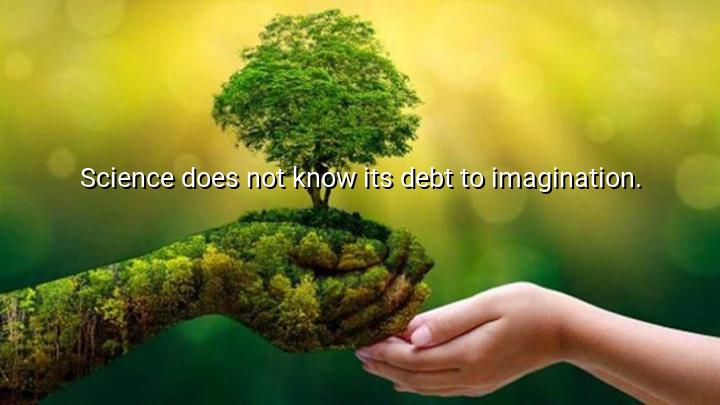




The quote "Science does not know its debt to imagination" by Ralph Waldo Emerson highlights the idea that imagination plays a crucial, yet often overlooked, role in scientific progress. Emerson suggests that while science is typically seen as a rigorous, fact-based discipline, it is deeply indebted to imagination—the ability to think creatively, hypothesize new ideas, and envision possibilities beyond what is currently known. Imagination is what allows scientists to explore uncharted territories, ask new questions, and devise experiments that push the boundaries of human knowledge.
The origin of this quote lies in Emerson’s broader philosophical views about the interconnection between different fields of human endeavor. As a leading figure in the Transcendentalist movement, Emerson believed in the power of the mind and spirit to connect with the deeper truths of nature and the universe. He saw imagination not just as a tool for art or literature but as a vital force in all forms of human inquiry, including science. For Emerson, creativity and imagination were essential for the discovery of new truths, even in the most logical and structured fields.
Emerson’s statement underscores that science does not operate in a vacuum of pure logic but is driven by the creative insights and visions of individuals. Whether in the development of scientific theories, the invention of new technologies, or the discovery of previously unknown phenomena, imagination is the catalyst for these breakthroughs. Imagination allows scientists to see beyond the data and predict what could be possible, fueling innovation and driving progress in ways that science alone cannot.
In essence, Emerson’s quote serves as a reminder that science, despite its reputation for being grounded in empirical evidence, is heavily influenced by imagination. Imagination sparks curiosity, encourages exploration, and enables scientists to ask bold questions and propose groundbreaking ideas. Without imagination, science would lack the creative drive that propels it forward, making imagination just as essential to the advancement of knowledge as observation and experimentation.

AAdministratorAdministrator
Welcome, honored guests. Please leave a comment, we will respond soon