

Science can purify religion from error and superstition. Religion can purify science from idolatry and false absolutes.
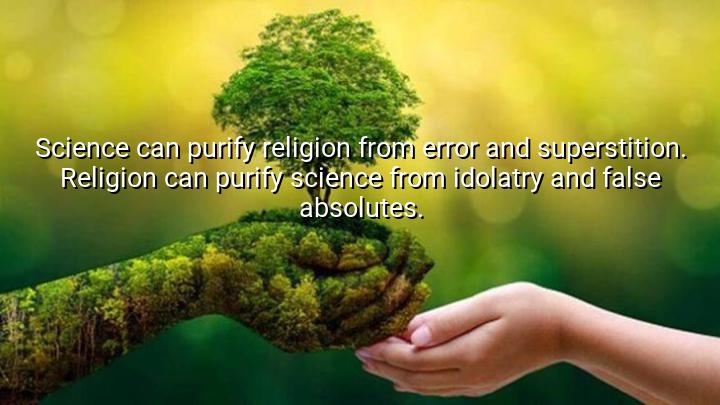




The quote "Science can purify religion from error and superstition. Religion can purify science from idolatry and false absolutes" by Pope John Paul II explores the relationship between science and religion, urging a complementary rather than adversarial approach. The Pope suggests that science has the ability to correct or refine religious beliefs by challenging superstitions and misconceptions that may arise from an overly literal or dogmatic interpretation of religious teachings. On the other hand, religion can guide science by reminding it to avoid turning into an idol or believing in absolute truths that dismiss the mystery and spiritual dimensions of human existence.
The first part of the quote, “Science can purify religion from error and superstition,” suggests that the pursuit of knowledge and empirical evidence can help challenge outdated or irrational religious practices. For example, scientific discoveries can shed light on misunderstandings or misinterpretations of religious doctrines that may have been influenced by cultural or historical contexts rather than true spiritual insight. Science, in this view, serves as a tool for refining and evolving religious understanding, bringing clarity and deeper truth.
The second part, “Religion can purify science from idolatry and false absolutes,” points out that religion has a role in keeping science grounded and humble. Without ethical guidance, science can be misused to promote idolatry, where human knowledge is revered above all else, or to assert false absolutes that ignore the complexity and mystery of the universe. Religion, with its emphasis on humility, ethics, and transcendence, can remind scientists of the limits of human knowledge and the importance of respecting human dignity and the mysteries of existence that cannot be fully explained by science alone.
The origin of this quote is rooted in Pope John Paul II’s broader view on the relationship between faith and reason. Throughout his papacy, he sought to reconcile faith with modern science, advocating for a dialogue that respects both the intellectual pursuit of truth and the spiritual dimensions of life. This view was articulated in his famous 1998 address to the Pontifical Academy of Sciences, where he acknowledged that both science and religion are paths to understanding the truth about the world and humanity, but each must help refine the other to avoid misguided extremes.

AAdministratorAdministrator
Welcome, honored guests. Please leave a comment, we will respond soon