

Sadly, in the highest levels of economic thought in government, questions are not tolerated. It is as if we're dealing with the binary thinking of a fundamentalist religion.
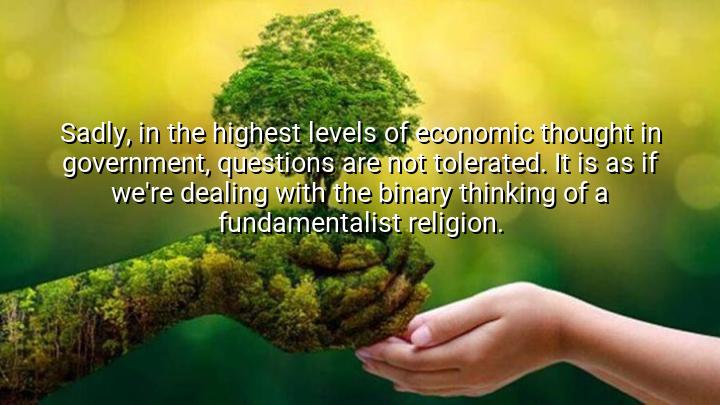




In this quote, Michael Burry, an investor known for predicting the 2008 financial crisis, critiques the way economic thought and decision-making are handled at the highest levels of government. He argues that questions—especially challenging or critical ones—are often ignored or repressed in favor of rigid, predetermined approaches. By likening this to the binary thinking of fundamentalist religion, Burry suggests that economic discourse has become overly dogmatic, focusing on black-and-white solutions instead of allowing for nuanced, open-ended discussions about complex issues.
Burry's comparison to fundamentalist religion underscores his frustration with how economic policies are often treated as inflexible or unquestionable truths. In fundamentalism, belief is unwavering and questions are not welcome, and Burry argues that the same mentality exists in how some economic or governmental decisions are made. He suggests that this leads to a lack of critical thinking and innovation, stifling alternative ideas or more effective solutions. For Burry, a healthy society requires the freedom to ask difficult questions and to entertain a variety of perspectives, especially in areas as important as economics.
The origin of this quote stems from Burry’s long-standing critique of both economic systems and government institutions. Known for his unconventional methods, Burry rose to prominence for betting against the subprime mortgage market before the 2008 financial crash, a move that earned him widespread recognition. His quote is reflective of his broader views on how economic systems, particularly in government and finance, can become insular and resistant to change. His experiences in the financial world have shaped his belief that the status quo often inhibits progress, especially when it is supported by a culture that avoids critical questioning.
Ultimately, Burry’s quote is a call for intellectual openness and honest dialogue in the fields of economics and policy-making. He emphasizes the importance of questioning established practices and recognizing that complex issues do not always have simple, binary solutions. By warning against dogmatic thinking, Burry encourages a more flexible, inquisitive approach to tackling the challenges facing governments and economies today.

AAdministratorAdministrator
Welcome, honored guests. Please leave a comment, we will respond soon