

Religious people often prefer to be right rather than compassionate. Often, they don't want to give up their egotism. They want their religion to endorse their ego, their identity.
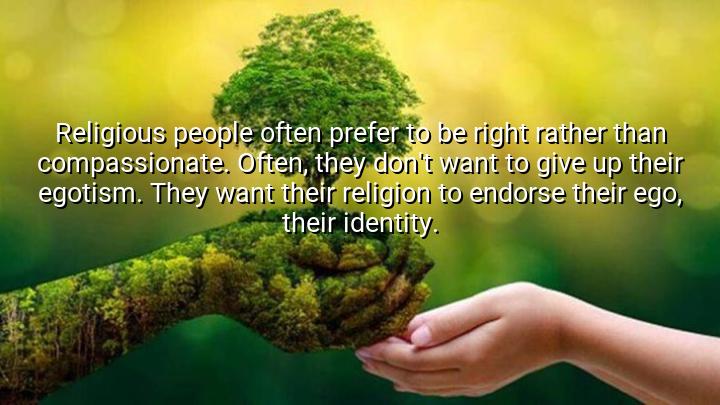




In this quote, Karen Armstrong critiques a common tendency among some religious individuals to prioritize being right over being compassionate. She suggests that for many, religion can become a tool to justify their ego and identity, rather than a path to true humility and empathy. Armstrong highlights the self-centeredness that can emerge when people use religious beliefs not to transcend their ego, but to reinforce it. This observation speaks to the potential danger of turning religion into an instrument of self-justification rather than a means of fostering understanding and kindness.
Armstrong, a former nun turned religious scholar, has dedicated much of her career to exploring the intersection of religion, humanity, and compassion. In her writings, she often examines how faith can be distorted by human ego. She argues that the true teachings of most religions emphasize compassion, humility, and service to others, but that these core messages can be overshadowed when individuals or groups use religion to bolster their own sense of superiority or moral rightness.
The origin of this quote can be traced to Armstrong’s broader critique of religious dogmatism and the misuse of faith. Throughout her career, she has spoken against the way in which religions have sometimes been manipulated to serve the interests of power, control, or personal gain. This perspective is often present in her works, such as The Case for God and A History of God, where she delves into the historical and cultural contexts that shape how religions are practiced. In this particular quote, she is warning against the potential for egoism to overshadow the more transformative and selfless aspects of faith.
Ultimately, Armstrong’s quote calls for a reflection on how we engage with religion in our lives. It challenges us to consider whether we are using our faith to serve others with compassion and understanding, or whether we are using it to serve our own ego and desire for validation. Her words encourage individuals to focus on the deeper, more humbling aspects of spirituality, reminding us that the essence of religion should be about service, love, and compassion, not just about being right.

AAdministratorAdministrator
Welcome, honored guests. Please leave a comment, we will respond soon