

Religion often partakes of the myth of progress that shields us from the terrors of an uncertain future.
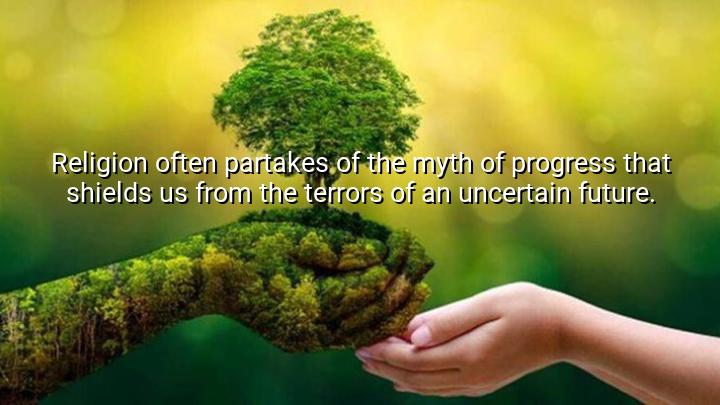




The quote "Religion often partakes of the myth of progress that shields us from the terrors of an uncertain future" by Frank Herbert delves into the relationship between religion and the human need for security in the face of an unpredictable future. Herbert suggests that religion, like many other systems of belief, often constructs a narrative of progress—the idea that life is steadily moving toward a better, more enlightened state. This comforting myth helps shield people from the fear of uncertainty and the chaos of an unpredictable world, offering a sense of meaning and direction amidst life's inherent unpredictability.
Frank Herbert, best known for his science fiction novel series "Dune," often explored themes of human psychology, power, and social structures. In his writing, Herbert frequently examined how belief systems—including religion—can be both a source of comfort and a tool for manipulation. The quote reflects his understanding that, while religion can offer solace and a framework for understanding the world, it also tends to perpetuate myths of progress or certainty that can obscure the chaotic and unpredictable nature of existence.
The origin of this quote can be traced to Herbert's philosophical views on human nature and his exploration of how societies and belief systems evolve. In his Dune series, he critiques the dangers of dogmatic systems—whether religious, political, or social—that promise a clear path forward while ignoring the complexity and unpredictability of human life. Herbert’s acknowledgment of uncertainty as an inherent part of the human condition reflects his broader belief that the pursuit of absolute certainty, whether through religion or other ideologies, can be misleading.
Ultimately, the quote calls attention to the illusion of progress often embedded in religious and ideological frameworks. Herbert’s words suggest that, while religion can provide comfort and meaning, it also often reinforces the idea that there is a clear, linear path to a better future, thereby protecting us from confronting the uncertainty and unpredictability that life truly entails. By acknowledging this myth, Herbert invites us to question the narratives we construct to make sense of an uncertain world.

AAdministratorAdministrator
Welcome, honored guests. Please leave a comment, we will respond soon