

Religion is there to say, 'Hey, you don't have to worry - there's an afterlife.'
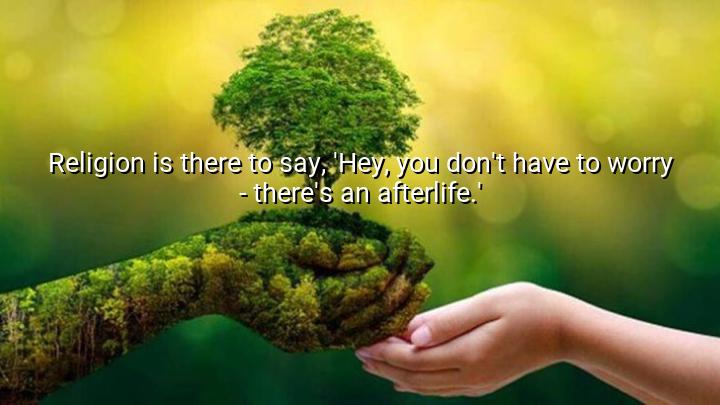




Peter Greenaway’s quote, "Religion is there to say, 'Hey, you don't have to worry - there's an afterlife,'" reflects his interpretation of religion as a comforting and reassuring system that provides people with a sense of security about life beyond death. Greenaway, a renowned British director known for his unique and sometimes provocative works, is pointing out that religion serves to alleviate existential concerns by offering the hope of an afterlife, an existence beyond the limitations and challenges of the physical world. In this sense, religion becomes a tool for coping with the fear and uncertainty surrounding death and the meaning of life.
The quote highlights how religion provides answers to fundamental human questions about mortality and the unknown. By promising an afterlife, religious systems can ease the anxieties that arise from the fear of non-existence after death. This sense of reassurance can be deeply comforting, allowing individuals to navigate the challenges of earthly life with the belief that their existence continues in another form. Greenaway’s perspective suggests that religion, in this context, can serve as a form of emotional support rather than an active guide to moral or spiritual behavior.
Greenaway’s statement also touches on the idea that religion might be more about psychological comfort than about a set of moral teachings or divine commandments. He implies that the concept of the afterlife may be used to ease the minds of believers, offering a resolution to the fears and uncertainties that inevitably arise when confronting death. In this light, religion becomes a coping mechanism, providing a framework that assures people that their existence does not end with their physical death.
Ultimately, Greenaway's quote reflects a somewhat pragmatic view of religion—seeing it less as a moral or philosophical system and more as a psychological safeguard against the fear of death. It raises questions about the purpose of religion and how it shapes our perception of life and death, emphasizing its role in offering comfort and reassurance about what may lie beyond this world.

AAdministratorAdministrator
Welcome, honored guests. Please leave a comment, we will respond soon