

Religion is all good, but we are almost back to medieval times now, where we are obsessed with going into religious wars and electing our politicians based on their religious statements.
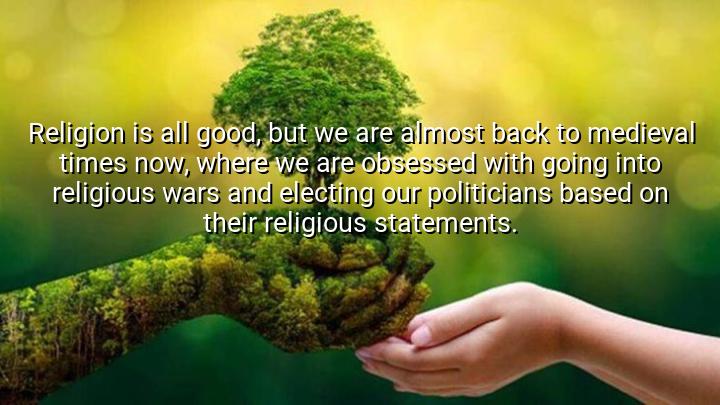




The quote by Lexi Alexander, "Religion is all good, but we are almost back to medieval times now, where we are obsessed with going into religious wars and electing our politicians based on their religious statements," highlights the tension between religion as a source of good and the way it is often used to fuel conflict and division in contemporary society. Alexander seems to argue that while religion itself can be a positive force, it has increasingly been used as a means to justify violence, political manipulation, and polarization. She draws a parallel to the medieval times, when religious differences were often at the root of wars and social strife, suggesting that in the modern age, we are dangerously repeating these patterns.
As a director and activist, Alexander is known for her outspoken views on social issues and political engagement. Her quote reflects a growing concern that religion is becoming a tool for political gain rather than a force for unity or compassion. In her view, the obsession with using religious beliefs to determine political candidates or to justify conflicts has regressed society to a state reminiscent of earlier historical periods, when religious authority dominated and led to sectarian violence. This speaks to a modern dilemma, where religion, instead of fostering peace, has become a divisive force in both public and private life.
The origin of this quote stems from Alexander's deep concern about the growing influence of religion in politics, especially in countries where religion is intertwined with political decisions and public policy. It reflects her frustration with the way in which religion has become a weapon in the hands of those seeking power, rather than a source of healing and reconciliation. Her statement critiques the dangerous intersections between faith and political power, which can often lead to extremism and the erosion of more secular, inclusive values in governance.
Ultimately, Alexander’s quote is a cautionary statement about the dangers of allowing religion to dominate political discourse and to fuel conflict rather than promote peace. She calls for a more thoughtful, balanced approach to the role of faith in public life, advocating for tolerance, reason, and a separation of religion from the divisive forces of political agendas. By pointing out the historical repetition of these patterns, she urges us to recognize the destructive potential of using religion as a tool for division rather than a source of common ground.

AAdministratorAdministrator
Welcome, honored guests. Please leave a comment, we will respond soon