

Religion. A daughter of Hope and Fear, explaining to Ignorance the nature of the Unknowable.
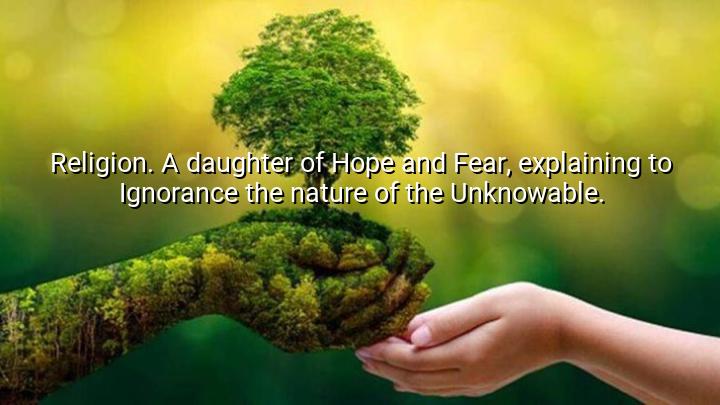




The quote "Religion. A daughter of Hope and Fear, explaining to Ignorance the nature of the Unknowable." by Ambrose Bierce is a satirical commentary on the nature of religion and its role in human life. Bierce, known for his cynical and ironic views, suggests that religion arises from hope and fear, two of the most powerful emotions that drive human behavior. According to Bierce, religion serves as an attempt to address the unknown and unexplainable aspects of existence, offering people comfort and explanation in the face of uncertainty.
In this quote, hope and fear are described as the parents or origins of religion. Hope represents the desire for meaning, salvation, or comfort in the face of life’s hardships, while fear arises from the unknown aspects of life, such as death and the mysteries of existence. Religion, according to Bierce, is a product of these powerful emotions, created to provide answers and security where reason and knowledge are lacking. Through religion, people seek to reconcile their fears and desires for something greater than themselves.
Bierce’s reference to "Ignorance" underscores his view that religion is often used to explain the unexplainable, attempting to offer clarity or a sense of control over forces that are inherently mysterious. Religion, in this context, is a tool that tries to shed light on the Unknowable—the mysteries of life, existence, and the afterlife—even though, according to Bierce, it often does so through doctrines that are not grounded in rationality or empirical knowledge. This implies that religion can be a way of satisfying human curiosity and the need for answers, despite its lack of factual certainty.
Ultimately, this quote reflects Bierce’s characteristic skepticism and irony. He suggests that while religion can provide comfort and explanation, it is not based on truth or knowledge but rather on the emotions of hope and fear, and it seeks to address what is, in his view, fundamentally unknowable. By framing religion in this way, Bierce offers a critique of the ways in which humans create systems of belief to manage uncertainty, while also acknowledging the power of religion in shaping human thought and culture.

AAdministratorAdministrator
Welcome, honored guests. Please leave a comment, we will respond soon