

One's happiness depends less on what he knows than on what he feels.
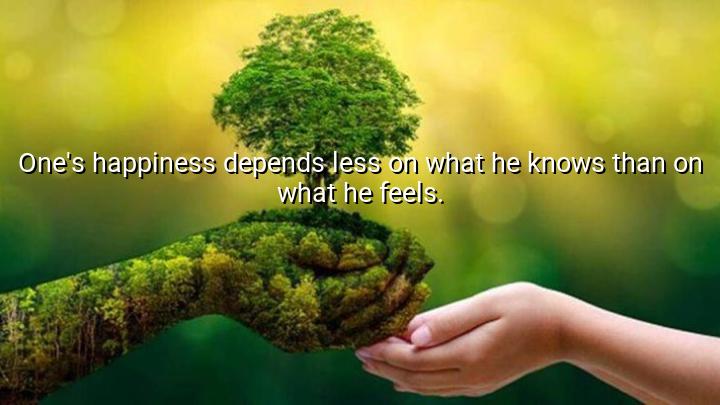




In this quote, Liberty Hyde Bailey emphasizes that happiness is more deeply influenced by what we feel rather than what we know. He suggests that emotional experiences and personal perceptions play a much larger role in shaping our sense of contentment than intellectual knowledge. This idea highlights the importance of emotional intelligence, where understanding and managing our feelings often leads to a more fulfilling and happy life than merely acquiring facts or knowledge.
Bailey’s statement speaks to the subjective nature of happiness, suggesting that it is an internal, emotional state rather than something determined by external achievements or intellectual prowess. The quote reflects the idea that, while knowledge is valuable, it is our emotional responses—our ability to feel joy, love, and peace—that truly define our overall sense of well-being. Happiness, therefore, is not something that can be achieved simply by learning or knowing more; it is more about how we process and experience life emotionally.
The origin of this quote comes from Liberty Hyde Bailey, an American horticulturist and environmentalist who was known for his contributions to agricultural education and his views on human connection with nature. Bailey often spoke on the relationship between nature, emotions, and well-being, and this quote reflects his belief that emotional and spiritual harmony is essential for happiness, often surpassing intellectual or material considerations.
Ultimately, Bailey’s words remind us that happiness is a personal and emotional experience. It suggests that no matter how much knowledge one may acquire, it is our ability to understand and manage our emotions that plays the most significant role in achieving true happiness. By focusing on emotional well-being and cultivating positive feelings, we can find contentment and fulfillment in life.

AAdministratorAdministrator
Welcome, honored guests. Please leave a comment, we will respond soon