

One has to go beyond the mind to experience the spiritual bliss of desirelessness.
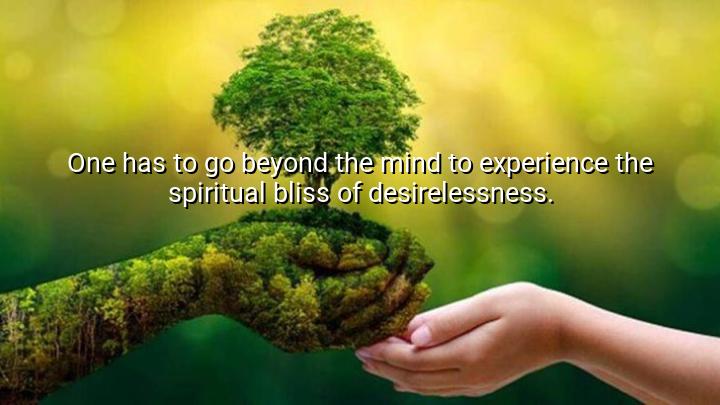




In this quote, Meher Baba emphasizes the idea that true spiritual bliss cannot be achieved through the mind alone. By stating, “One has to go beyond the mind,” he suggests that intellectual understanding or rational thought is not sufficient to grasp the deeper truths of spirituality. Instead, one must transcend mental processes and enter a state of inner stillness or consciousness that lies beyond ordinary thought. This is where the experience of desirelessness—a state free from longing or attachment—becomes possible.
The phrase “spiritual bliss of desirelessness” points to a core concept in many mystical and Eastern spiritual traditions: that inner peace arises not from fulfilling desires but from releasing them. Meher Baba teaches that the endless pursuit of worldly cravings creates suffering and illusion. It is only when one detaches from these desires and surrenders the ego that they can experience a profound sense of joy, freedom, and oneness with the divine.
Meher Baba, an Indian spiritual master active in the 20th century, became known for his teachings on love, silence, and the inner journey of the soul. He famously observed a vow of silence for over four decades, communicating through gestures and an alphabet board. His philosophy combined elements of Hinduism, Sufism, and Christian mysticism, and he often spoke about the illusion of the material world and the importance of transcending the ego to realize God-consciousness.
Ultimately, the quote reflects Meher Baba’s message that the path to true enlightenment is inward, not mental or material. It calls for a surrender of thought-driven identity and an embrace of pure being, where the divine joy of desirelessness naturally unfolds. This inner transformation leads to a state of spiritual liberation, where one no longer seeks but simply is.

AAdministratorAdministrator
Welcome, honored guests. Please leave a comment, we will respond soon