

Often the hands will solve a mystery that the intellect has struggled with in vain.
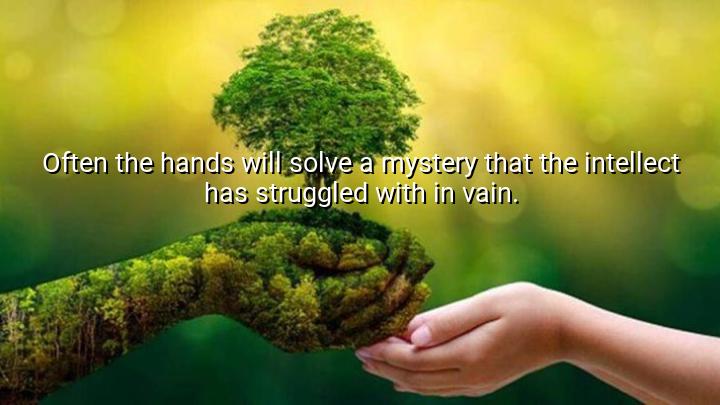




The quote "Often the hands will solve a mystery that the intellect has struggled with in vain" by Carl Jung suggests that sometimes the solutions to problems or mysteries are found through action and intuition rather than solely through intellectual analysis. Jung, a pioneering psychologist, highlights the value of hands-on experience and the unconscious processes that can guide problem-solving. While the mind may become stuck or overwhelmed by overthinking, engaging in physical tasks can often bring clarity and insight in ways that the intellect alone cannot.
Jung’s statement underscores the idea that conscious thought and rationality are not the only paths to understanding. Sometimes, engaging in creative or manual activities, such as drawing, crafting, or even simple physical movement, can allow deeper, more instinctual parts of the mind to come forward. These activities can help individuals access knowledge and understanding that may be buried beneath the surface of conscious thought. Jung believed that the unconscious mind could provide answers, and that by physically engaging with the world, we could tap into that deeper wisdom.
The origin of this quote stems from Jung’s exploration of the human psyche and his ideas on the balance between conscious and unconscious processes. Jung often emphasized the importance of symbolism, dreams, and intuition in uncovering deeper truths about the self. His work suggested that intellectual reasoning alone could be limiting, and that a more holistic approach, which includes the body and subconscious, leads to greater understanding and growth.
Ultimately, Jung’s quote encourages a more integrated approach to problem-solving, where both rational thought and physical action play essential roles. It suggests that intellect and hands-on experience complement each other, and sometimes stepping away from intellectual analysis can lead to breakthroughs that would otherwise remain elusive.

AAdministratorAdministrator
Welcome, honored guests. Please leave a comment, we will respond soon