

Of the twenty-two civilizations that have appeared in history, nineteen of them collapsed when they reached the moral state the United States is in now.
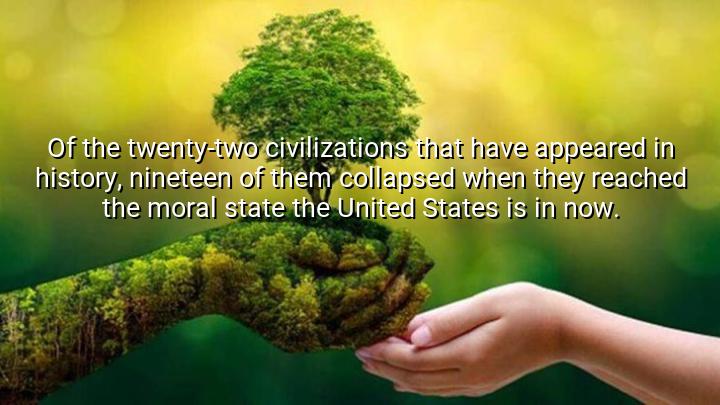




The quote by Arnold J. Toynbee is a warning about the connection between the moral condition of a society and the survival of civilizations. By stating that nineteen out of twenty-two civilizations collapsed after reaching a similar moral state, Toynbee suggests that when a nation falls into moral decay, corruption, or the loss of shared values, it becomes vulnerable to decline and eventual collapse. His words highlight the idea that the downfall of societies is not merely due to external threats, but often from internal weaknesses.
When he specifically refers to the United States, Toynbee is drawing a parallel between America’s contemporary moral state and the historical conditions that preceded the fall of earlier civilizations. This implies concerns about materialism, inequality, political corruption, cultural decline, or the erosion of civic responsibility. For Toynbee, morality and culture were as crucial as economics or military strength in sustaining a civilization.
The deeper meaning of the quote lies in Toynbee’s philosophy of cyclical history. He believed that civilizations rise, flourish, and fall in patterns, often determined by how they respond to challenges. Once a society loses its ethical foundation or sense of purpose, it begins to unravel from within. In this way, history serves as a cautionary tale, showing that no empire or nation is immune to decline.
The origin of this quote is tied to Toynbee’s monumental work, “A Study of History” (1934–1961), where he analyzed the development and collapse of major civilizations. As a British historian and philosopher, he sought to uncover the common factors that explained both growth and decline. This statement reflects his critical view of modern America during the 20th century, warning that without addressing its moral and cultural challenges, it might repeat the fate of earlier fallen civilizations.

AAdministratorAdministrator
Welcome, honored guests. Please leave a comment, we will respond soon