

O Lord, help me to be pure, but not yet.
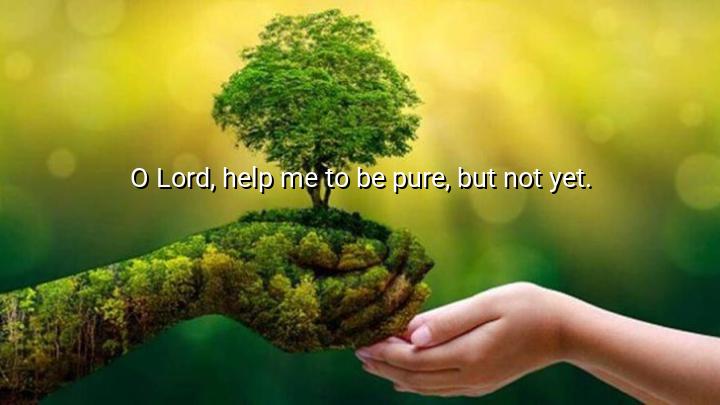




The quote, "O Lord, help me to be pure, but not yet," comes from Saint Augustine, a Christian theologian and philosopher whose writings have greatly influenced Western Christianity and philosophy. In this statement, Augustine humorously acknowledges his desire for spiritual purity, yet he simultaneously admits his reluctance to fully embrace it at that moment. The quote reflects the tension between the aspiration for moral or spiritual growth and the human tendency to resist change or give up worldly pleasures. Augustine is essentially asking for help in becoming a better person, but only when he is ready to fully commit to it.
The origin of this quote is tied to Augustine's confessions in which he expresses the inner conflict between his spiritual desires and the temptation of his earthly, sinful desires. It is a candid reflection of his struggle to reconcile his faith with his human nature. Augustine’s writings often explore the theme of grace and the challenge of overcoming sin—a personal battle that he admits to experiencing throughout his life. In this quote, he humorously expresses his hesitation in fully surrendering to the idea of purity, revealing a moment of honesty and self-awareness.
In a broader sense, the quote speaks to the universal human experience of wanting to improve oneself but also feeling torn by the attractions of pleasure, comfort, or habit. It highlights the difficulty of making radical changes in one’s life, particularly in the context of spirituality or morality, where the journey toward personal transformation often involves a struggle between what one desires and what one knows is better for them in the long run.
Ultimately, Augustine’s quote is a humorous yet honest reflection on the process of self-improvement and the challenge of fully committing to the higher ideals we strive for. It acknowledges that while we may seek to be better people, it often requires patience, grace, and a willingness to confront the complexity of our own desires and shortcomings. The quote encapsulates the human condition of desiring to be good while struggling with the process of getting there.

AAdministratorAdministrator
Welcome, honored guests. Please leave a comment, we will respond soon