

Now my children also don't have a particular religion as I also didn't have. The only difference is that now they have Muslim and Parsi also in their blood. So they may be called Hindu, Buddhist, Muslim, Sikh, Christian and Parsi!
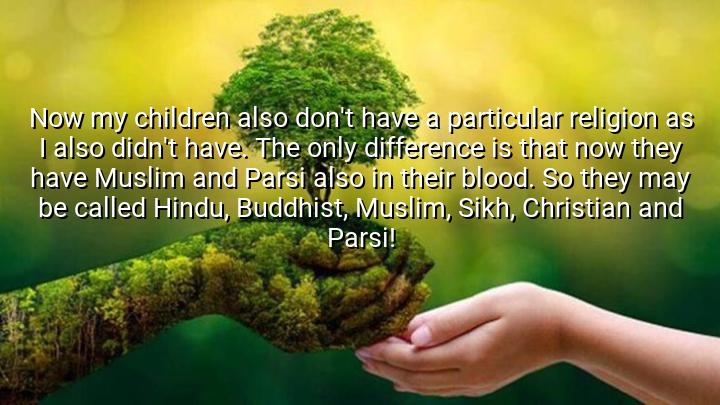




In this quote, Pooja Bedi, an Indian actress and socialite, reflects on her personal approach to religion and how it has influenced her children. She reveals that, like herself, her children do not adhere to a specific religion. This suggests that she embraces a more inclusive and open-minded view of spirituality, rather than being bound by traditional religious labels. The mention of her children having Muslim and Parsi heritage in their blood indicates that they come from a diverse cultural and religious background, further emphasizing the pluralistic nature of their upbringing.
Bedi’s words underscore the idea that religion is not a fixed identity but a complex, multifaceted concept that can encompass a variety of beliefs and traditions. By acknowledging that her children could be called by any number of religious identities—Hindu, Buddhist, Muslim, Sikh, Christian, or Parsi—she highlights the fluidity and inclusiveness of their cultural and spiritual heritage. She does not see religion as something that must be rigidly defined or imposed but rather as something that can be embraced in a way that respects diversity and personal freedom.
Her statement also challenges the idea of religious exclusivity, proposing that one’s identity doesn’t need to be confined to a single religious category. The notion of having multiple religious influences in one’s blood—without necessarily adhering to any one of them—suggests a more universal or humanistic view of spirituality. This idea reflects a broader trend in contemporary thinking, where people often reject the idea of being boxed into traditional religious structures in favor of a more eclectic or global approach to belief.
Ultimately, Pooja Bedi’s quote is a call for religious tolerance and the acceptance of diverse beliefs. It suggests that identity is more complex than simply belonging to a single religious group and that spirituality can be a blend of various traditions and experiences. By leaving her children’s religious identity open-ended, she encourages a worldview where individuals are free to draw from multiple spiritual and cultural influences, cultivating a sense of unity rather than division.

AAdministratorAdministrator
Welcome, honored guests. Please leave a comment, we will respond soon