

Nothing turns out to be so oppressive and unjust as a feeble government.
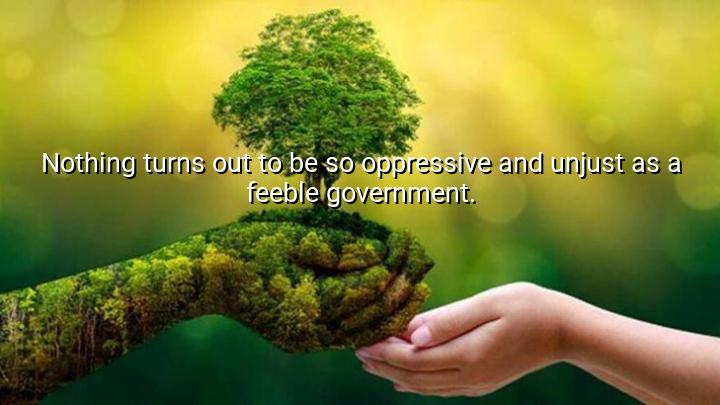




The quote by Edmund Burke, a British statesman and philosopher, suggests that a weak or ineffective government can be more harmful than a strong, oppressive one. By stating that "nothing turns out to be so oppressive and unjust as a feeble government," Burke argues that when a government lacks the strength or will to enforce laws and protect its citizens, it creates an environment where injustice and inequality can thrive. A feeble government fails to uphold the rule of law, leaving people vulnerable to exploitation and harm.
Burke’s statement emphasizes the importance of a strong government that can maintain order and ensure the protection of its people. While oppressive governments are typically associated with tyranny and abuse of power, Burke warns that a government that is too weak to function effectively leads to even greater harm, as it fails to provide the stability and security that society needs to flourish. In his view, weak leadership invites chaos and the erosion of justice.
This perspective is rooted in Burke’s broader political philosophy, which valued order, tradition, and responsible governance. He believed that a government should be capable of both protecting rights and providing for the common good, striking a balance between too much control and too little authority. A feeble government leaves room for corruption and the rise of powerful factions that can take advantage of the lack of oversight.
Ultimately, Burke’s quote serves as a cautionary reminder that government should not be passive or indifferent to the needs of its people. A government’s weakness can lead to the disintegration of social cohesion and the rise of injustice, making it crucial for leaders to have the resolve and authority to act decisively for the good of society.

AAdministratorAdministrator
Welcome, honored guests. Please leave a comment, we will respond soon