

Not until the human heart is stolid to poetry, the human eye blind to beauty, not until the intellect ceases its quest for truth and conscience finds its quietus either in universal defeat or in triumphant success, will organized religion cease to be.
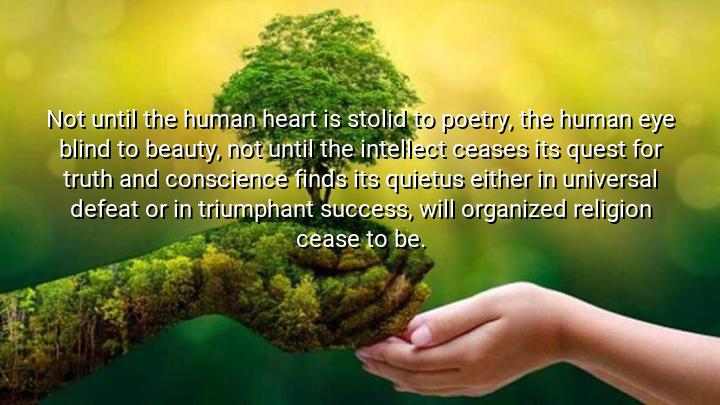




The quote by Jenkin Lloyd Jones reflects on the enduring nature of organized religion and its connection to essential aspects of human experience. Jones suggests that religion persists because the human heart continues to respond to poetry, the eye perceives beauty, the intellect seeks truth, and the conscience strives for moral understanding. In essence, religion exists as long as humans possess emotional, intellectual, and spiritual capacities that yearn for meaning, guidance, and transcendence.
The origin of this insight comes from Jones’ work as an American Unitarian minister and writer in the late 19th and early 20th centuries. He often explored the interplay between faith, reason, and the human spirit, advocating for a form of religion grounded in personal insight, moral integrity, and the pursuit of truth. His perspective emphasizes that religion is not merely an institution but a reflection of enduring human needs.
At its core, the quote conveys that the persistence of organized religion is tied to the human quest for meaning, aesthetic appreciation, knowledge, and ethical living. Jones implies that religion will only vanish if humans completely lose their capacity for wonder, reflection, and moral engagement—conditions that are unlikely to occur.
Ultimately, Jenkin Lloyd Jones’ words highlight the intrinsic connection between faith and fundamental human qualities. By acknowledging the enduring search for truth, beauty, and moral clarity, he presents religion as an enduring aspect of human civilization, shaped and sustained by the innate capacities of the heart, mind, and conscience.

AAdministratorAdministrator
Welcome, honored guests. Please leave a comment, we will respond soon