

Not the fruit of experience, but experience itself, is the end.
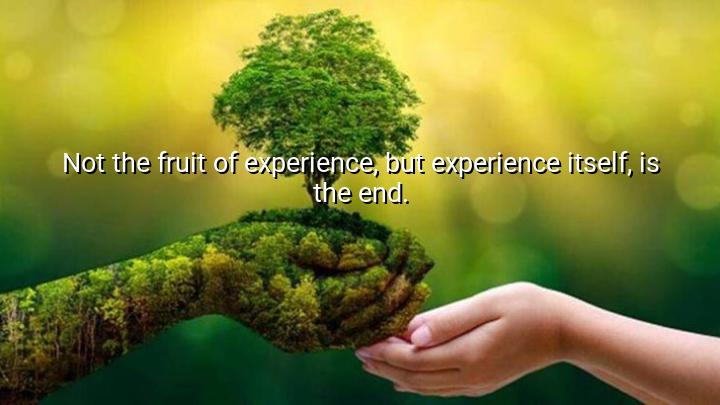




The quote by Walter Pater, "Not the fruit of experience, but experience itself, is the end," emphasizes the intrinsic value of living through experiences rather than merely focusing on the outcomes or lessons derived from them. Pater suggests that the process of experiencing—feeling, perceiving, and engaging with life—is valuable in its own right. This perspective encourages an appreciation for the moment-to-moment richness of life rather than viewing experiences solely as a means to gain knowledge or achieve specific results.
The origin of this quote lies in Walter Pater’s work as a 19th-century essayist and critic, especially known for his ideas on aestheticism and the philosophy of life. Pater believed that life’s purpose was to savor and immerse oneself in beauty and experience, treating existence as an art form. His statement reflects this ethos, emphasizing that the act of experiencing is itself meaningful, beyond any practical benefits or “fruits” it might yield.
This idea challenges the common tendency to see experiences only as stepping stones toward future gains, such as wisdom or success. Instead, Pater’s view invites us to embrace and value each experience for what it is, encouraging mindfulness and presence. It suggests a deeper, more poetic way of engaging with life where the journey holds as much significance as any destination.
In summary, Pater’s quote reminds us to cherish the present moment and the act of living itself. It teaches that experience is not merely a means to an end but a profound end in itself, urging us to fully inhabit and appreciate our daily encounters with the world.

AAdministratorAdministrator
Welcome, honored guests. Please leave a comment, we will respond soon