

Not longer loved or fostered by religion, beauty is lifted from its face as a mask, and its absence exposes features on that face which threaten to become incomprehensible to man.
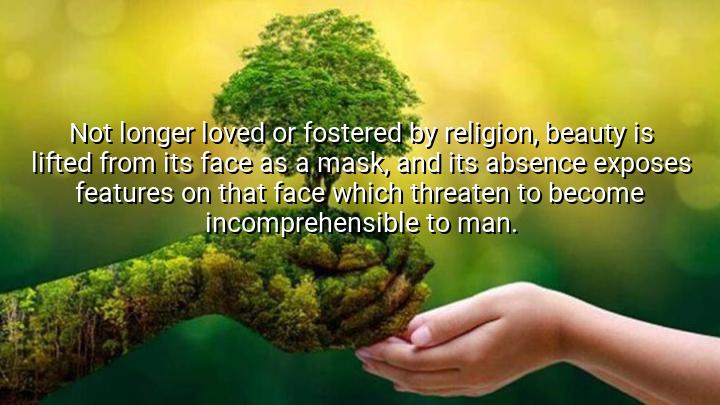




Hans Urs von Balthasar’s quote delves into the relationship between religion and beauty, suggesting that when beauty is no longer recognized or valued by religious thought, it loses its deeper significance. In the past, religion often held beauty in high regard, seeing it as a reflection of the divine and a means of connecting to the spiritual realm. However, when beauty is stripped of its religious context, it becomes a mask, hiding its true, transcendent meaning. Without this connection to the divine, beauty is reduced to a superficial appearance that can no longer reveal its full, deeper purpose.
Balthasar warns that when beauty is detached from its spiritual roots, its absence exposes aspects of the human experience that are hard to comprehend. The features of life, once seen through the lens of beauty as a divine attribute, may now seem incomprehensible or disconnected from any greater meaning. Beauty, in this sense, becomes a way to glimpse the transcendent, but without religion, its significance becomes clouded, and people may struggle to understand its deeper implications.
As a prominent theologian and philosopher, Balthasar was deeply interested in how the divine interacts with human experience, particularly through the arts, including beauty. His works often emphasized the idea that the aesthetic experience, when tied to religion, can reveal deeper truths about the nature of God and the human soul. In this quote, he laments the modern loss of this connection, where beauty no longer serves as a bridge to the sacred, and its absence results in a fragmented understanding of human existence.
Ultimately, Balthasar’s quote invites reflection on the role of beauty in human life. He challenges modern society’s tendency to reduce beauty to mere appearance, urging a return to a more holistic understanding of beauty that is intertwined with the spiritual and the divine, recognizing that beauty, when properly understood, has the power to offer profound insights into the nature of reality and the human condition.

AAdministratorAdministrator
Welcome, honored guests. Please leave a comment, we will respond soon