

Not ignorance, but ignorance of ignorance, is the death of knowledge.
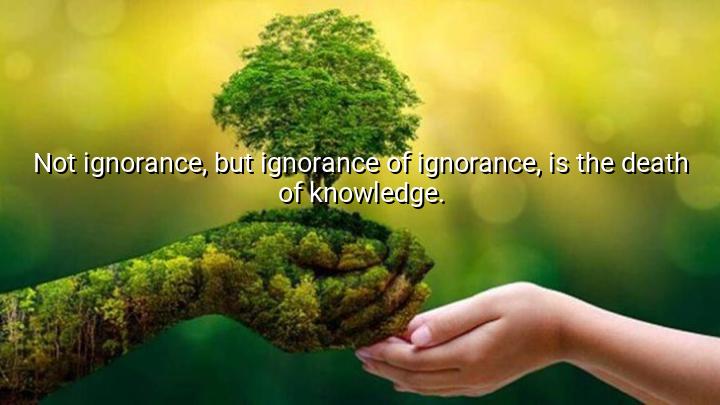




The quote "Not ignorance, but ignorance of ignorance, is the death of knowledge" by Alfred North Whitehead emphasizes a deeper form of ignorance that is more detrimental than simple lack of information. Whitehead, a renowned philosopher and mathematician, suggests that when people are unaware of their ignorance, they are less likely to seek knowledge or truth. It’s not the absence of knowledge itself that hinders intellectual progress, but the failure to recognize that one doesn’t know something, which prevents learning or growth.
Whitehead’s concept of ignorance of ignorance points to a state of complacency or arrogance where individuals believe they know everything, thus closing themselves off from new ideas and perspectives. This type of ignorance is dangerous because it limits the possibility of expanding one’s understanding. When people fail to acknowledge their own gaps in knowledge, they are not motivated to question or learn, leading to stagnation in personal and collective progress.
The idea in this quote can be applied to various fields, from education to scientific discovery. In any area of study, knowledge is built on recognizing what is unknown and striving to fill those gaps. Ignorance of ignorance can create a false sense of certainty, preventing deeper inquiry and critical thinking. Whitehead, therefore, warns that this kind of ignorance is far more dangerous than mere lack of knowledge because it undermines the very process of learning.
Ultimately, Whitehead’s quote advocates for a mindset of humility and self-awareness. Recognizing one’s own ignorance is a necessary step in the pursuit of knowledge and understanding. It encourages openness to learning and self-reflection, which are essential for intellectual and personal growth.

AAdministratorAdministrator
Welcome, honored guests. Please leave a comment, we will respond soon