

Nonsense and beauty have close connections.
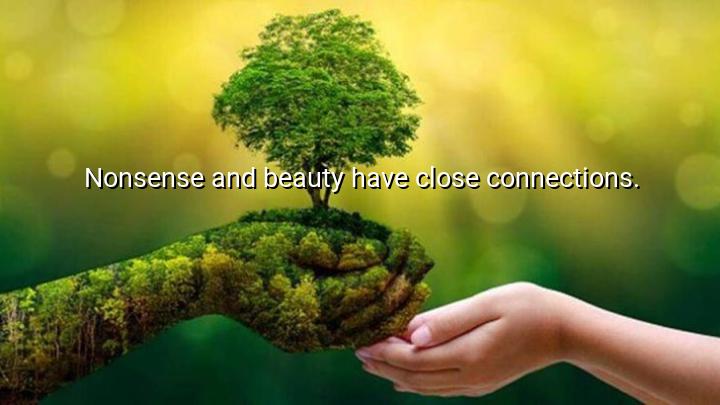




The quote "Nonsense and beauty have close connections" by E. M. Forster suggests that there is a surprising link between the seemingly illogical or absurd (nonsense) and the profound or aesthetically pleasing (beauty). Forster, a celebrated English novelist, is pointing out that sometimes the most beautiful or thought-provoking things in life may arise from what initially seems nonsensical or irrational. This connection implies that creativity, often associated with beauty, can emerge from unconventional or unexpected sources, challenging traditional boundaries of sense and logic.
Forster's observation may reflect his understanding that art and literature, much like life itself, are filled with paradoxes. Sometimes, beauty arises not from perfect logic or order but from embracing the chaos and randomness of nonsense. This could be seen in works of art or writing where seemingly absurd ideas spark deep reflection or emotional resonance. The absurdity might make us reconsider the way we view the world, offering fresh perspectives that conventional reasoning cannot.
Moreover, Forster’s quote invites us to think about how the combination of nonsense and beauty can reveal a more complete understanding of the human experience. By acknowledging that things don’t always need to make sense to be beautiful, we open ourselves to appreciating the less tangible, more subjective aspects of life, such as imagination, emotion, and spontaneity. Beauty, in this sense, becomes less about rigid definitions and more about the feelings or ideas it evokes.
Ultimately, Forster’s remark is a reflection on the complexity of beauty and its relationship to other elements of life, including those we might dismiss as nonsensical. He suggests that by embracing the nonsense, we may uncover new and unexpected forms of beauty, thus broadening our understanding of what is truly valuable and meaningful in art and life.

AAdministratorAdministrator
Welcome, honored guests. Please leave a comment, we will respond soon