

No religion has mandated killing others as a requirement for its sustenance or promotion.
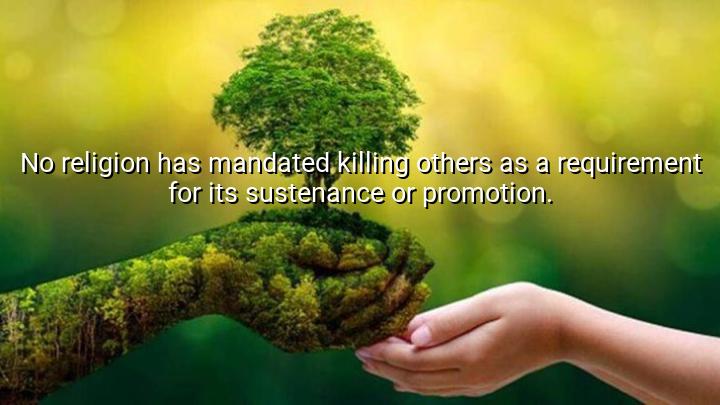




In this quote, A. P. J. Abdul Kalam, an esteemed Indian scientist and former president, makes a profound statement about the nature of religion. He asserts that no religion inherently requires violence or killing as part of its doctrine or to ensure its growth or sustenance. Kalam challenges the common misconception that religion encourages or justifies violence, particularly in the context of conflict or war. His statement suggests that the true teachings of religion should center around peace, compassion, and coexistence, not violence or intolerance.
Kalam’s words also address the misuse of religion by individuals or groups to justify acts of terrorism, extremism, or warfare. He emphasizes that the essence of religious teachings, whether Islam, Christianity, Hinduism, or any other faith, is not about violence but about promoting human dignity, love, and spiritual growth. In this way, Kalam advocates for a more holistic and inclusive understanding of religion, one that transcends harmful misinterpretations and calls for unity and understanding across faiths.
The origin of this quote is rooted in Kalam's philosophy of peace and his vision for a unified world. As a man of science and spirituality, he was a strong proponent of the idea that science and religion could coexist and contribute positively to society. Throughout his life, Kalam worked to promote interfaith dialogue, emphasizing that the purpose of religion should be to bring people together, rather than divide them. His deep belief in the oneness of humanity led him to speak out against the violence often associated with religious conflict.
Ultimately, this quote serves as a reminder that religion, in its true form, is a force for good and should not be used to justify destruction or hatred. Kalam’s words encourage individuals to reflect on the core teachings of their faiths, which emphasize compassion, peace, and mutual respect. By focusing on these fundamental values, people can help build a more harmonious and understanding world, where differences in belief are celebrated rather than used as a cause for conflict.

AAdministratorAdministrator
Welcome, honored guests. Please leave a comment, we will respond soon