

No part of the world can be truly understood without a knowledge of its garment of vegetation, for this determines not only the nature of the animal inhabitants but also the occupations of the majority of human beings.
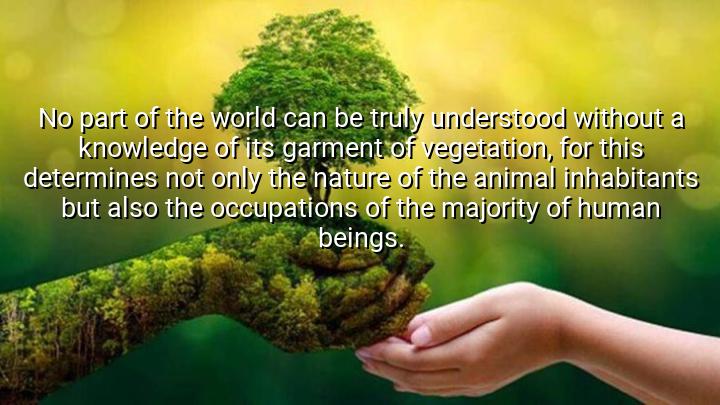




The quote by Ellsworth Huntington emphasizes the crucial role of vegetation and natural environment in shaping both human and animal life. By stating, “No part of the world can be truly understood without a knowledge of its garment of vegetation,” Huntington suggests that the study of plants, forests, and crops is essential to comprehending the broader ecological and social systems of any region. Vegetation acts as a fundamental context that influences climate, resources, and the overall character of a place.
Huntington points out that vegetation affects animal life, noting that the distribution and behavior of animals are directly influenced by the plants and natural habitats available. Moreover, humans are equally affected, as “this determines not only the nature of the animal inhabitants but also the occupations of the majority of human beings.” In other words, agriculture, hunting, trade, and settlement patterns are shaped by the types of plants that flourish in a given region, linking environmental knowledge to economic and social activities.
Ellsworth Huntington, an American geographer and climatologist of the late 19th and early 20th centuries, focused on the interaction between environment, climate, and human society. He was known for exploring how geographical and ecological factors influence civilization and human behavior. This quote reflects his belief that understanding a region’s natural characteristics, especially vegetation, is key to interpreting the patterns of life and development within it.
Ultimately, the quote encourages a holistic view of geography, highlighting that to fully understand any part of the world, one must consider its ecological framework. Huntington reminds us that plants are not merely scenery, but foundational elements that shape animal populations, human occupations, and societal structures, making knowledge of vegetation essential to understanding the world.

AAdministratorAdministrator
Welcome, honored guests. Please leave a comment, we will respond soon