

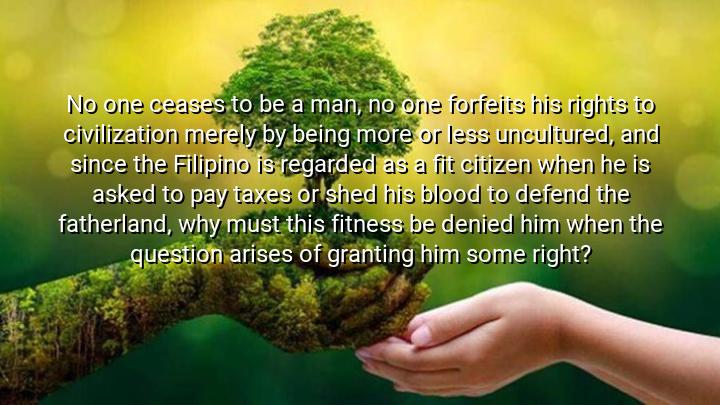
No one ceases to be a man, no one forfeits his rights to civilization merely by being more or less uncultured, and since the Filipino is regarded as a fit citizen when he is asked to pay taxes or shed his blood to defend the fatherland, why must this fitness be denied him when the question arises of granting him some right?
No one ceases to be a
No one ceases to be a man, no one forfeits his rights to civilization merely by being more or less uncultured, and since the Filipino is regarded as a fit citizen when he is asked to pay taxes or shed his blood to defend the fatherland, why must this fitness be denied him when the question arises of granting him some right?

No one ceases to be a
No one ceases to be a man, no one forfeits his rights to civilization merely by being more or less uncultured, and since the Filipino is regarded as a fit citizen when he is asked to pay taxes or shed his blood to defend the fatherland, why must this fitness be denied him when the question arises of granting him some right?
No one ceases to be a
No one ceases to be a man, no one forfeits his rights to civilization merely by being more or less uncultured, and since the Filipino is regarded as a fit citizen when he is asked to pay taxes or shed his blood to defend the fatherland, why must this fitness be denied him when the question arises of granting him some right?
No one ceases to be a
No one ceases to be a man, no one forfeits his rights to civilization merely by being more or less uncultured, and since the Filipino is regarded as a fit citizen when he is asked to pay taxes or shed his blood to defend the fatherland, why must this fitness be denied him when the question arises of granting him some right?
No one ceases to be a
No one ceases to be a man, no one forfeits his rights to civilization merely by being more or less uncultured, and since the Filipino is regarded as a fit citizen when he is asked to pay taxes or shed his blood to defend the fatherland, why must this fitness be denied him when the question arises of granting him some right?
No one ceases to be a

The quote by Jose Rizal addresses the fundamental idea of fitness in the context of citizenship and rights. Rizal argues that being uncultured or less educated does not diminish a person’s humanity or their entitlement to rights. He points out that Filipinos are considered fit citizens when it comes to fulfilling duties such as paying taxes or defending the nation, yet they are often denied fitness when it comes to being granted rights. This exposes a contradiction in how fitness is defined and applied in society.

Rizal challenges the idea that fitness for citizenship should be limited to certain privileges or responsibilities while excluding basic rights. His words call for a more just and inclusive understanding of what it means to be a fit member of society—one that includes both obligations and entitlements. This quote highlights the struggle for equal rights and recognition faced by Filipinos during the colonial period.

As a national hero of the Philippines and a prominent advocate for reform and justice, Jose Rizal wrote extensively about the social and political inequalities of his time. This quote reflects his broader mission to fight for the dignity and rights of his people, emphasizing that true fitness encompasses both contribution and entitlement.

In essence, the quote teaches that fitness as a citizen should not be narrowly defined or used to deny rights. It promotes the idea that all individuals deserve full recognition and respect within society, regardless of their level of education or culture.

Jose Rizal
Jose Rizal

Filipino - Writer June 19, 1861 - December 30, 1896

Have 0 Comment No one ceases to be a

AAdministratorAdministrator

Welcome, honored guests. Please leave a comment, we will respond soon

Reply.
Information sender
Leave the question
Click here to rate
Information sender
0.33473 sec| 2560.383 kb