

No matter your religion, philosophy, or political beliefs, violence is not the way to achieve peace.
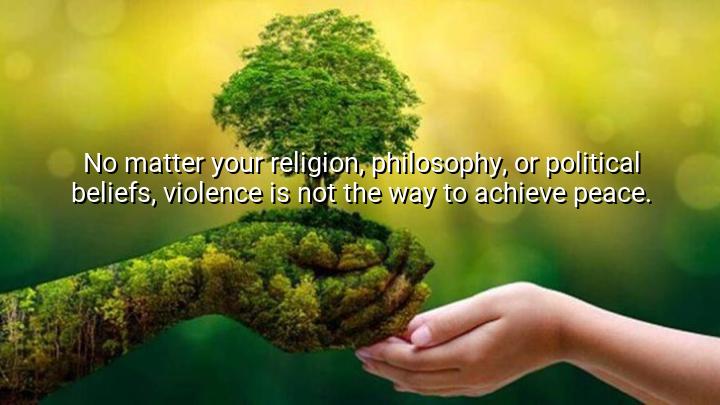




The quote by Nancy Mace emphasizes that violence is not an effective or ethical means to achieve peace, regardless of one’s religion, philosophy, or political beliefs. Mace, an American politician, underscores the universality of this principle, suggesting that ethical action and nonviolent approaches are essential for resolving conflicts. The statement highlights that peace cannot be imposed through force, coercion, or aggression, and that any attempt to do so undermines its true purpose.
The origin of the quote lies in Mace’s reflections on civic responsibility and ethical leadership. Speaking in the context of social, political, and global challenges, she advocates for dialogue, compromise, and mutual understanding as the foundations for sustainable peace. Her statement reflects a broader commitment to nonviolence and moral integrity in public life, emphasizing the importance of addressing differences constructively rather than destructively.
By including religion, philosophy, and political beliefs, Mace emphasizes that this principle applies to everyone, transcending ideological or cultural differences. She suggests that reliance on violence, even in the name of justice or belief, ultimately perpetuates conflict rather than resolving it. True peace, in her view, requires empathy, patience, and collaborative effort.
Ultimately, the quote serves as a reminder and ethical guideline that achieving peace demands moral courage and principled action rather than force. Mace encourages individuals and societies to seek solutions rooted in understanding, dialogue, and nonviolent engagement, underscoring the universal value of peaceful conflict resolution.
I can also create a condensed version emphasizing only the key keywords and ideas for quick reference.

AAdministratorAdministrator
Welcome, honored guests. Please leave a comment, we will respond soon