

No innovation in the past 200 years has done more to save lives and improve health than the sanitation revolution triggered by invention of the toilet. But it did not go far enough. It only reached one-third of the world.
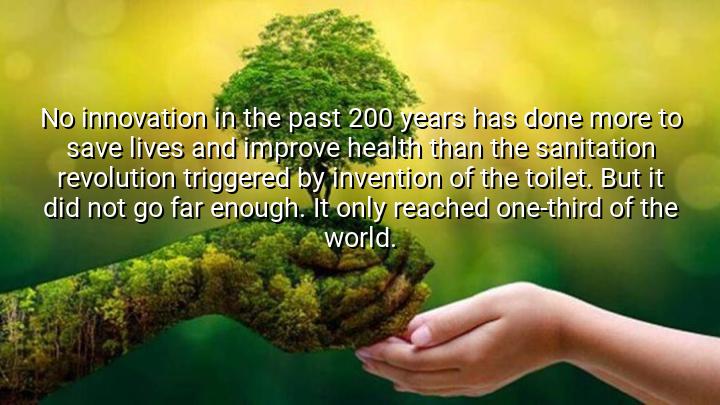




Sylvia Mathews Burwell’s quote highlights the profound impact of the sanitation revolution, particularly the invention of the toilet, on global health and life expectancy. She asserts that no innovation in the past two centuries has done more to save lives and improve health than the widespread adoption of sanitation systems, which drastically reduced the spread of diseases and improved living conditions. However, Burwell points out that this breakthrough did not fully reach the entire globe, with only one-third of the world’s population benefiting from proper sanitation systems.
The origin of Burwell's insight comes from her work in global health and her recognition of the importance of public health infrastructure. As a former Secretary of Health and Human Services and a prominent figure in global health initiatives, Burwell has seen firsthand how significant advancements in sanitation can be in improving public health. She understands that while the toilet revolutionized health for many, it has not been universally accessible, especially in developing regions.
Burwell’s statement underscores the inequity that exists in global health infrastructure. While the invention of the toilet was groundbreaking in terms of reducing the spread of diseases like cholera and diarrhea, access to sanitation remains a challenge for a large portion of the world's population. This gap in access means that a significant number of people still live without the health benefits that modern sanitation provides, leaving them vulnerable to preventable diseases.
Ultimately, Burwell’s quote calls attention to the unfinished work in achieving global health equity. While sanitation systems have made tremendous progress, she emphasizes that there is still much work to be done to ensure that everyone has access to the health benefits of basic sanitation, particularly in the developing world. Her statement serves as a reminder of the need for continued efforts in addressing global health disparities.

AAdministratorAdministrator
Welcome, honored guests. Please leave a comment, we will respond soon