

Needless to say, oftentimes a 'religion' is not needed to breed extremism. People breed it all by themselves, oftentimes with the subjective morality of modern secularism breeding the worst kind.
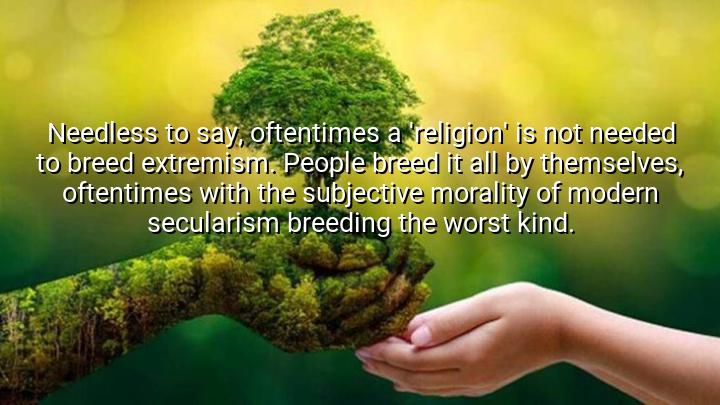




In this quote, Steven Crowder, a conservative commentator, challenges the conventional idea that religion is the primary source of extremism. He argues that extremism can emerge without the influence of any particular religious doctrine. Instead, he suggests that it is possible for individuals to foster extreme views based purely on subjective morality, which can sometimes arise within modern secularism. Crowder points out that when moral values are viewed as relative or subjective—without a clear, universal standard—they can become a breeding ground for extreme beliefs and actions.
Crowder’s critique centers on the idea that secularism, which often promotes moral relativism, can be just as dangerous as religious extremism in fueling radical or harmful ideologies. He argues that without a clear moral framework, people may justify extreme actions or beliefs based solely on their personal or ideological biases. This, in turn, can lead to a moral vacuum where individuals feel justified in taking extreme actions in the name of their beliefs, regardless of whether those beliefs are grounded in religion or secular principles.
The reference to modern secularism highlights a growing trend in contemporary society where traditional religious values are being replaced by more fluid, individualistic interpretations of right and wrong. Crowder suggests that this shift could be equally, if not more, problematic because it lacks the stable foundation that religious morality often provides. When moral codes become subjective, it can be easier for people to justify extremist actions, as there is no absolute measure of what is right or wrong, leading to greater polarization and division.
Ultimately, Crowder’s quote raises a warning about the potential dangers of moral relativism in any form, whether rooted in religion or secularism. It suggests that extremism is not limited to religious contexts, but can emerge whenever people abandon universal moral standards, relying instead on their personal or collective interpretations of right and wrong.

AAdministratorAdministrator
Welcome, honored guests. Please leave a comment, we will respond soon