

Nature creates while destroying, and doesn't care whether it creates or destroys as long as life isn't extinguished, as long as death doesn't lose its rights.
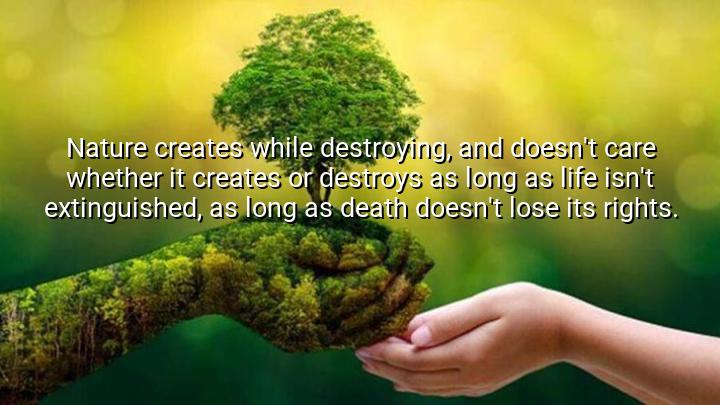




The quote "Nature creates while destroying, and doesn't care whether it creates or destroys as long as life isn't extinguished, as long as death doesn't lose its rights" by Ivan Turgenev reflects a philosophical perspective on the cyclical and indifferent nature of life. Turgenev suggests that nature operates without moral concern, constantly creating and destroying in a never-ending cycle. The balance between creation and destruction is inherent to the natural world, and nature doesn't take sides, as long as the essential processes of life and death continue. It underscores the idea that life and death are fundamental aspects of existence, and nature follows its own path without regard for human judgments of what is good or bad.
Turgenev's words suggest that nature is indifferent to the outcomes of its actions—whether it builds up life or tears it down—it is all part of an inevitable cycle. The quote emphasizes that the essential order of nature relies on death as much as it does on life, implying that both are necessary for the ongoing existence of the world. In this view, death isn't something to be feared or avoided but is an integral part of the natural process that allows for continual renewal and growth.
The origin of this quote comes from Ivan Turgenev, a Russian novelist and playwright best known for works like Fathers and Sons. Turgenev was deeply interested in the complexities of human nature, society, and the forces of life and death. His works often explored philosophical themes of existentialism, change, and the tensions between different generations and ideologies, and this quote reflects his contemplation of the natural world and its indifferent yet essential processes.
Ultimately, Turgenev’s quote serves as a reminder of the duality within nature: creation and destruction, life and death. It suggests that nature operates with a level of indifference, where the only constant is the balance between these forces. By acknowledging both aspects as equally vital to the continuity of life, Turgenev offers a broader understanding of how nature works beyond human notions of morality and control.

AAdministratorAdministrator
Welcome, honored guests. Please leave a comment, we will respond soon