

My mind withdrew its thoughts from experience, extracting itself from the contradictory throng of sensuous images, that it might find out what that light was wherein it was bathed... And thus, with the flash of one hurried glance, it attained to the vision of That Which Is.
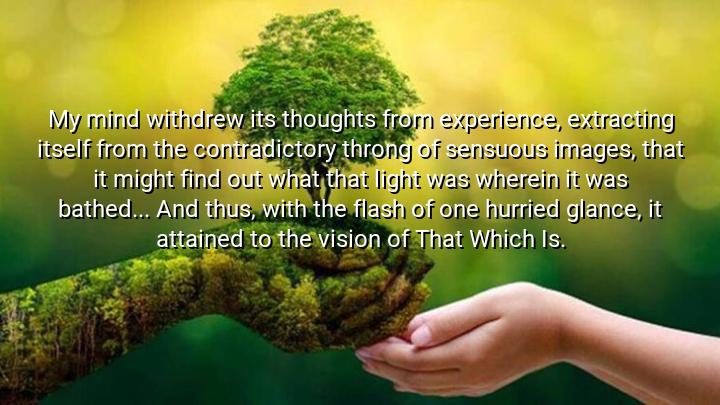




Saint Augustine’s quote, “My mind withdrew its thoughts from experience, extracting itself from the contradictory throng of sensuous images, that it might find out what that light was wherein it was bathed... And thus, with the flash of one hurried glance, it attained to the vision of That Which Is,” reflects his deep contemplation on the nature of reality and the pursuit of truth. Augustine speaks about the moment when his mind steps away from the distractions of the physical world and the sensory images that often cloud understanding. He seeks a deeper understanding of the light—a metaphor for divine truth or enlightenment—that exists beyond the material world.
The quote conveys the tension between the world of senses and the inner pursuit of truth. Augustine is describing the process of withdrawal from external distractions, which are often filled with contradiction and confusion. By turning inward and detaching from the clutter of sensory input, he is able to access a higher level of awareness or clarity, symbolized by the flash of insight. This sudden glance gives him a profound vision of That Which Is, an allusion to the ultimate truth or divine reality, often interpreted as God in Augustine's philosophy.
This experience can be seen as a form of spiritual awakening, where the mind, by disengaging from the chaos of the physical world, is able to glimpse a more profound and eternal reality. The flash of insight reflects the idea that enlightenment or understanding may come suddenly, almost intuitively, when the mind is receptive and free from the distractions of worldly concerns. It suggests that true understanding of the divine or the fundamental truth of existence requires a shift in focus from the external to the internal.
The origin of this quote is rooted in Augustine's philosophical and theological work, particularly in his book Confessions. As one of the most influential figures in Christian philosophy, Augustine often explored the relationship between the senses, reason, and faith. His writings reflect a quest to understand how humans can move beyond superficial sensory experiences to grasp deeper spiritual truths. This quote encapsulates his belief in the necessity of inner reflection and withdrawal from external distractions to perceive divine truth.

AAdministratorAdministrator
Welcome, honored guests. Please leave a comment, we will respond soon