

My country is the world, and my religion is to do good.
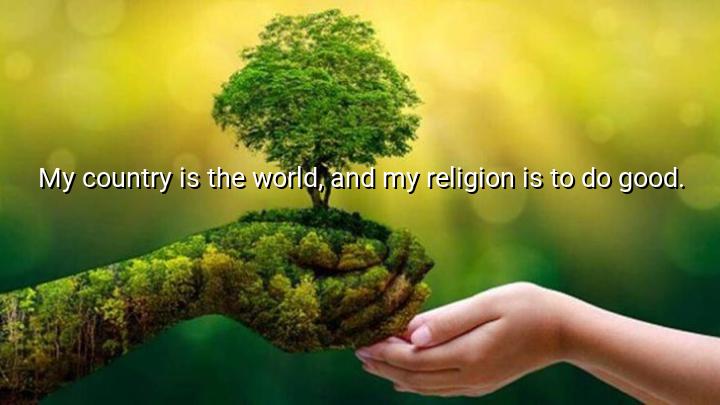




The quote "My country is the world, and my religion is to do good" by Thomas Paine expresses a vision of universalism and humanitarianism, emphasizing that one's sense of national identity should extend beyond borders and that one's moral responsibility lies in doing good for all of humanity. Paine suggests that true patriotism is not confined to the allegiance to a single country, but rather to the broader ideal of promoting goodness and justice on a global scale. In this view, one's religion or guiding principle is not tied to specific doctrines or traditions, but to the universal value of doing good to others.
Paine, a key figure in the American Revolution and a proponent of enlightenment values, was a strong advocate for individual rights, freedom, and equality. His rationalist and secular approach to life often led him to reject traditional organized religions, focusing instead on moral actions that contribute to the welfare of all people, irrespective of their nation or creed. In this quote, he aligns his sense of duty with universal ethics, positioning humanity as his true community and compassion as the highest religious calling.
The origin of this quote is rooted in Paine’s broader philosophical outlook, which can be found in his writings like The Age of Reason and Common Sense. Paine’s skepticism of traditional religion and nationalism is well-documented, as he believed that religion should be defined by reason and righteous action, not by adherence to a particular set of beliefs. His personal beliefs and activism reflected a commitment to the idea that humans, regardless of their national or religious identities, have a shared responsibility to each other to make the world a better place.
In essence, Paine’s quote reflects his commitment to universal humanism and the belief that the purpose of life is to contribute positively to the global community. By placing his allegiance to humanity above national or religious boundaries, he advocates for a moral framework that transcends divisions and urges people to live lives focused on goodness, kindness, and service to others. This perspective remains relevant today, encouraging individuals to act out of a sense of shared humanity rather than narrow, divisive loyalties.

AAdministratorAdministrator
Welcome, honored guests. Please leave a comment, we will respond soon