

My books are elegiac in the sense that they're odes to a nation that even I sometimes think may not exist anymore except in my memory and my imagination.
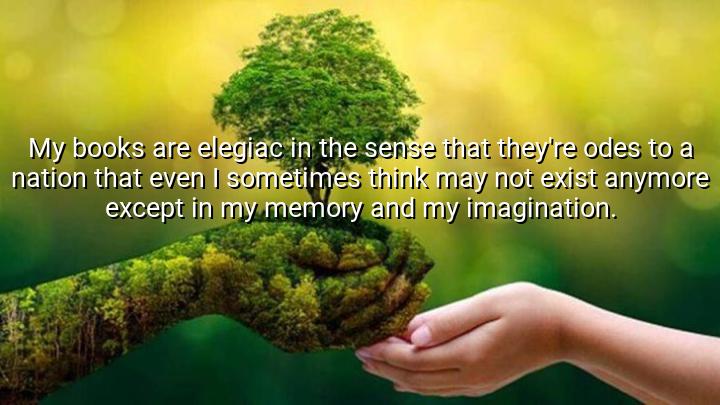




In this quote, Richard Russo reflects on the nature of his writing, describing his books as elegiac—a term typically used to describe works that mourn or express sorrow for something lost. Russo suggests that his novels are odes to a nation, one that he sometimes feels may no longer exist except in his memory and imagination. The sense of loss he conveys is not only personal but also cultural, as he grapples with the idea that the country he once knew may have transformed in ways that feel irreparable.
The term elegiac emphasizes that Russo’s works reflect a sense of nostalgia for a past that is slipping away. He sees his books as a tribute to a way of life, a nation, or an era that has changed, perhaps beyond recognition. The use of memory and imagination in the quote reveals that this lost nation exists not in the present but in the subjective realm of his thoughts and recollections. This adds a layer of emotional depth to his work, as he captures the essence of something that may no longer physically exist but remains alive in the collective and personal imagination.
Russo’s statement also alludes to a broader theme of change and the passage of time. The idea that a nation’s identity can evolve to the point where it no longer resembles what it once was invites readers to think about the impact of cultural and social shifts on individuals and communities. It raises the question of how memory can shape our perceptions of the past and influence how we move forward in the present.
Ultimately, Russo’s quote speaks to the power of memory and imagination in preserving what may be lost. His books serve as a tribute to a nation, both real and imagined, that exists in his consciousness and through his writing. It highlights the ability of literature to immortalize not just events but emotions and experiences that may be fading from the physical world.

AAdministratorAdministrator
Welcome, honored guests. Please leave a comment, we will respond soon