

Must not all things at the last be swallowed up in death?
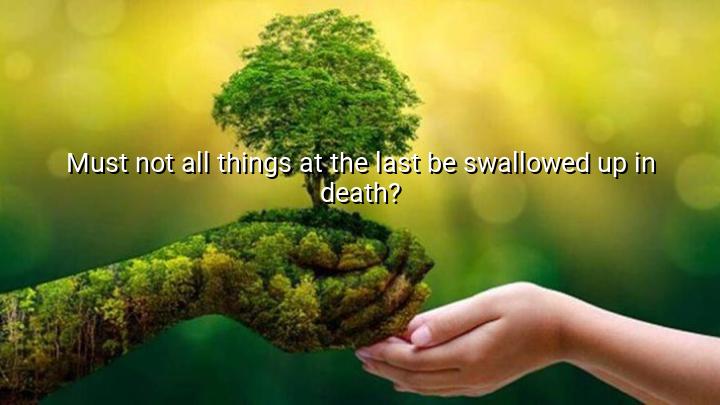




The quote, "Must not all things at the last be swallowed up in death?" comes from Plato, the ancient Greek philosopher known for his foundational contributions to Western philosophy. In this statement, Plato reflects on the inevitability of death and the transient nature of life. By suggesting that "all things" are ultimately "swallowed up in death," he emphasizes the idea that mortality is a universal truth that affects everyone and everything, regardless of accomplishments or status.
This quote is rooted in Plato's exploration of existence, life, and death in his philosophical dialogues, particularly in works like Phaedo and The Republic. For Plato, death represents the end of the physical world and the soul’s transition to an eternal existence. He often used the concept of death to reflect on the importance of living a virtuous life, as the soul is seen as being eternal and separate from the body. This quote highlights his belief that, while life is fleeting, what truly matters is the state of the soul.
The origin of the quote is tied to Plato’s views on epistemology and ethics, where he frequently examined the relationship between the material world and the realm of eternal truths. Plato’s perspective on death is not one of despair, but of reflection. His philosophical framework often considered the soul’s journey beyond the body, suggesting that what happens after death is of greater importance than the material life itself.
Ultimately, this quote serves as a reminder of mortality, urging individuals to consider the impermanence of life and the need to live in alignment with higher virtues. By contemplating the inevitability of death, Plato encourages a focus on the soul's eternal journey, rather than the fleeting pleasures and distractions of the physical world.

AAdministratorAdministrator
Welcome, honored guests. Please leave a comment, we will respond soon