

Morality without religion is only a kind of dead reckoning - an endeavor to find our place on a cloudy sea by measuring the distance we have run, but without any observation of the heavenly bodies.
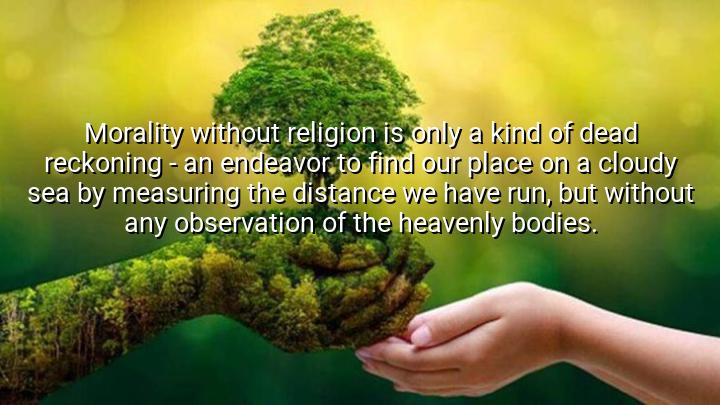




The quote by Henry Wadsworth Longfellow emphasizes the connection between morality and religion. Longfellow suggests that morality without religion is limited and uncertain, likening it to dead reckoning—a method of navigation that estimates position based on distance traveled, but without reference to the heavenly bodies. This metaphor implies that without a higher spiritual or religious framework, moral decisions can lack guidance and certainty.
At its core, the quote explores the idea that religion provides direction and structure for ethical behavior. Just as navigators rely on the stars to find their way across a cloudy sea, individuals rely on spiritual principles to guide their choices. Without this framework, moral reasoning can be imprecise and vulnerable to error, leaving individuals to navigate complex situations without a clear compass.
The origin of this quote comes from Longfellow’s reflections on ethics, spirituality, and human nature. As a 19th-century poet and philosopher, Longfellow often explored themes of faith, morality, and the human search for meaning. This statement reflects his belief that religion and spirituality are essential anchors for living a moral and purposeful life, providing both clarity and stability.
The keywords—morality, religion, dead reckoning, cloudy sea, measuring the distance, heavenly bodies—capture the essence of Longfellow’s message: morality alone, without spiritual guidance, can be uncertain and directionless. The quote emphasizes the importance of religion as a moral compass, helping individuals navigate the complexities of life with insight and purpose.
I can also create a shorter, 2-paragraph version highlighting all the bold keywords for quick reference if you want.

AAdministratorAdministrator
Welcome, honored guests. Please leave a comment, we will respond soon