

Mistakes are, after all, the foundations of truth, and if a man does not know what a thing is, it is at least an increase in knowledge if he knows what it is not.
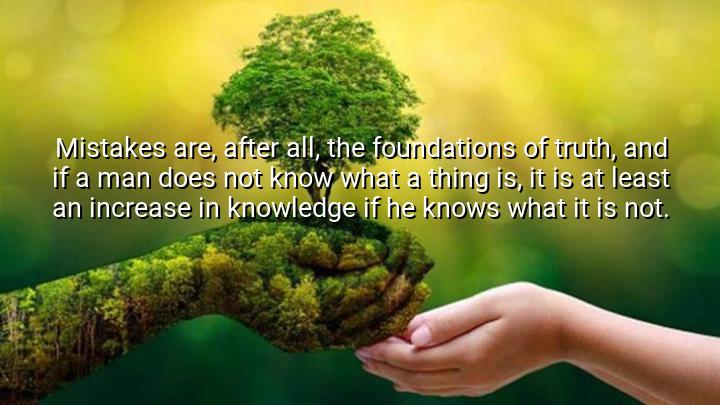




The quote by Carl Jung, "Mistakes are, after all, the foundations of truth, and if a man does not know what a thing is, it is at least an increase in knowledge if he knows what it is not," emphasizes the value of errors in the pursuit of understanding. Jung, a prominent psychologist and the founder of analytical psychology, often explored the human mind's journey toward self-awareness and wisdom. Here, he reminds us that mistakes are not merely failures but essential steps toward discovering truth. Each error provides a chance to learn, refine judgment, and grow intellectually.
The first part of the quote, that mistakes serve as the "foundations of truth," suggests that every wrong assumption or action helps clarify what is accurate or meaningful. In other words, without making errors, one cannot fully appreciate or recognize the truth. Jung’s perspective aligns with his broader ideas about the unconscious mind, where confronting and understanding one's failures can lead to deeper self-knowledge and insight.
The second part highlights the benefit of negative knowledge: knowing what something is not still represents an increase in understanding. Even when we cannot define something positively, eliminating misconceptions moves us closer to clarity. This reflects Jung’s belief that human growth often comes through exploration, experimentation, and reflection rather than just immediate success.
Historically, Jung’s work focused on the human psyche, archetypes, and the process of individuation, which is the path toward becoming a whole, self-aware individual. This quote exemplifies his philosophy that learning and self-discovery are iterative processes, often built on trial, error, and introspection. By valuing mistakes as steps toward truth and seeing missteps as a source of knowledge, Jung provides a timeless reminder of the constructive role of failure in personal and intellectual development.

AAdministratorAdministrator
Welcome, honored guests. Please leave a comment, we will respond soon