

Many think of memory as rote learning, a linear stuffing of the brain with facts, where understanding is irrelevant. When you teach it properly, with imagination and association, understanding becomes a part of it.
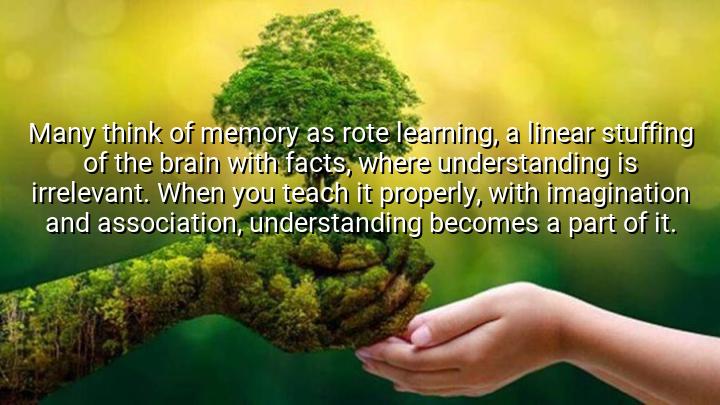




The quote "Many think of memory as rote learning, a linear stuffing of the brain with facts, where understanding is irrelevant. When you teach it properly, with imagination and association, understanding becomes a part of it" by Tony Buzan challenges the traditional view of memory and learning. Buzan, a renowned expert on mind mapping and brain training, critiques the common approach to memorization, which often relies on rote learning — a mechanical and repetitive process of memorizing facts without deeper understanding. He argues that this method is ineffective because it doesn't engage the mind's natural ability to associate information and make connections, which are crucial for true learning.
Buzan's quote emphasizes the role of imagination and association in enhancing memory. Rather than treating memory as a simple storage of facts, he advocates for an approach that makes use of the mind's creative and associative nature. When we connect new information to something we already know, using our imagination to form meaningful relationships, the brain is more likely to retain and understand that information. This process leads to a more holistic and meaningful form of learning, where understanding is integrated with memory.
The quote also highlights the difference between passive and active learning. Rote learning is passive, often leading to short-term retention of information without real comprehension. In contrast, using imagination and association to teach involves actively engaging the mind, allowing students to not only remember facts but also understand the context and application of that knowledge. This makes learning more engaging and effective, as it encourages deeper thinking and personal connection with the material.
Ultimately, Buzan’s quote advocates for a more dynamic and interactive approach to learning and memory. By combining imagination with logical associations, individuals can move beyond memorization and foster a deeper, more lasting understanding of the material. It encourages educators and learners alike to move away from mechanical methods of memorization and embrace techniques that stimulate the mind and facilitate genuine learning and comprehension.

AAdministratorAdministrator
Welcome, honored guests. Please leave a comment, we will respond soon