

Mankind is considered (by the radical environmentalists) the lowest and the meanest of all species and is blamed for everything.
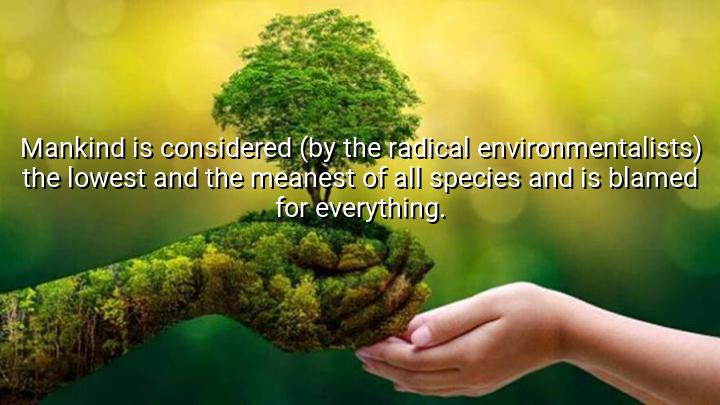




The quote, "Mankind is considered (by the radical environmentalists) the lowest and the meanest of all species and is blamed for everything," by Dixie Lee Ray, reflects her criticism of radical environmentalists and their view of humanity in relation to the environment. Ray, a former U.S. politician and environmental activist, suggests that some extreme factions within the environmental movement hold humankind responsible for nearly all of the planet's problems, often portraying humanity as the root cause of environmental degradation. In this view, humans are seen as the most harmful species, blamed for causing climate change, pollution, and habitat destruction.
Ray's statement critiques the tendency of some environmentalists to focus solely on the negative impacts of human activities without fully considering the complexities of human existence and the role of industrialization and technological advancement in shaping modern society. She implies that this perspective can be overly simplistic and even unfair, ignoring the positive contributions humanity has made in areas such as medicine, technology, and social progress. By painting humanity in such a negative light, radical environmentalism, according to Ray, may overlook the more balanced, nuanced approach that includes both the benefits and drawbacks of human existence.
The phrase "the lowest and the meanest of all species" underscores the extreme view that some radical environmentalists hold about humanity’s place in the natural world. This idea contrasts with more moderate environmental views, which tend to recognize human impact but advocate for sustainable practices and coexistence with nature rather than portraying humans as inherently destructive. Ray’s quote suggests that the over-simplification of this belief can lead to a divisive and counterproductive approach to solving environmental problems.
Ultimately, Ray’s quote serves as a critique of radical environmentalism and its portrayal of humanity as inherently negative. She argues that focusing too much on blaming mankind can hinder the creation of collaborative solutions for environmental challenges, instead of encouraging more inclusive and pragmatic approaches to environmental protection that take into account the complexities of human development and ecological sustainability.

AAdministratorAdministrator
Welcome, honored guests. Please leave a comment, we will respond soon