

Man wants to live, but it is useless to hope that this desire will dictate all his actions.
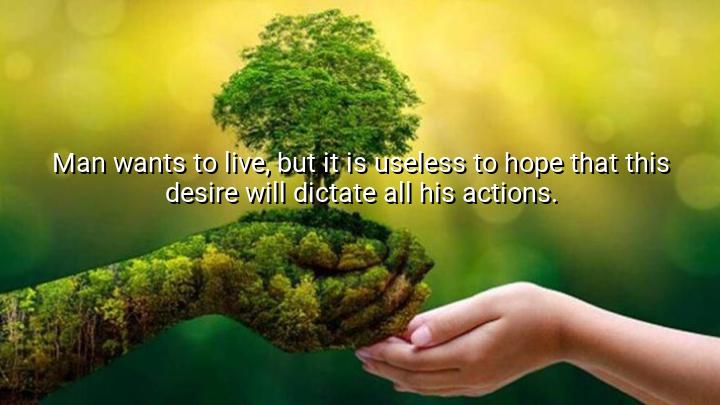




The quote "Man wants to live, but it is useless to hope that this desire will dictate all his actions" by Albert Camus reflects his existential philosophy, particularly the tension between human desire and the limitations of the human condition. Camus is pointing out that while every person inherently wants to live, this fundamental desire does not necessarily guide all of their choices or behaviors. Instead, various factors such as fear, societal influences, personal doubts, or even a sense of absurdity often shape human actions, making the path to survival and meaning much more complex than merely desiring life.
The quote suggests that human nature is fraught with contradictions. While we may all have an instinctual drive to preserve and cherish life, there are moments when our actions do not align with this instinct. For example, people may make decisions that are self-destructive or seemingly indifferent to their survival. Camus touches on the absurdity of human existence, where the desire to live may conflict with other aspects of life, such as the search for meaning or the challenge of accepting life’s inherent uncertainty.
The origin of this quote lies in Camus' broader body of work, particularly his exploration of the absurd in books like The Myth of Sisyphus. In this essay, Camus argues that life’s lack of inherent meaning leads to a confrontation with the absurd—the conflict between humans' desire for meaning and the indifferent universe. The quote reflects his belief that the human condition is defined by this struggle and that individuals must come to terms with it by embracing life, despite its contradictions and challenges.
Ultimately, this quote highlights the complexity of human existence. While desire for life is universal, it does not always lead to rational or life-affirming actions. Camus' philosophy calls for a deep understanding of life’s contradictions and encourages individuals to live authentically, even in the face of an absurd world. By acknowledging that desire and action do not always align, he challenges people to reflect on their choices and embrace the uncertainty and complexity of human existence.

AAdministratorAdministrator
Welcome, honored guests. Please leave a comment, we will respond soon