

Man is not logical and his intellectual history is a record of mental reserves and compromises. He hangs on to what he can in his old beliefs even when he is compelled to surrender their logical basis.
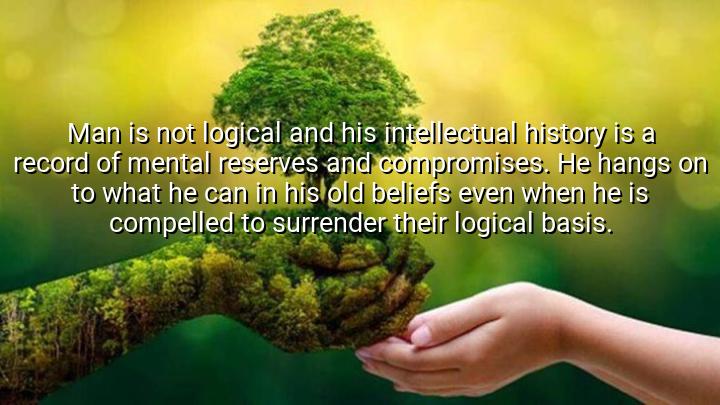




The quote "Man is not logical and his intellectual history is a record of mental reserves and compromises. He hangs on to what he can in his old beliefs even when he is compelled to surrender their logical basis," by John Dewey, speaks to the inherent contradictions in human thought and reasoning. Dewey suggests that humans are often unwilling to fully let go of their beliefs, even when those beliefs are no longer supported by rational or logical evidence. This resistance to change reflects the complexity of human cognition, where emotional attachment to old ideas often overrides logical reasoning.
Dewey's statement reflects his broader philosophy of pragmatism, which emphasizes the practical application of thought in solving real-world problems, rather than strict adherence to abstract logic. He believed that human thought is often shaped by experience and context, leading to compromises and adjustments rather than purely logical conclusions. The quote implies that intellectual history is filled with these mental reserves—beliefs that people hold onto even when they no longer make sense in light of new evidence or better reasoning.
The origin of the quote lies in Dewey’s work on education, democracy, and human development. He saw the process of intellectual growth as one that requires flexibility and openness to change, but also recognized that people are prone to holding onto old beliefs due to emotional, social, or psychological reasons. The tension between rationality and tradition is a central theme in his philosophy, and this quote reflects his view that the development of thought is often a messy process of reconciling the past with the present.
Ultimately, Dewey's words remind us that intellectual evolution is not purely a logical or linear process. Instead, it is shaped by the psychological and emotional aspects of human nature, where beliefs are deeply ingrained and hard to relinquish. This tension between logic and tradition continues to influence how we think, learn, and adapt to new ideas, highlighting the complexity of human thought in the face of changing circumstances.

AAdministratorAdministrator
Welcome, honored guests. Please leave a comment, we will respond soon