

Love seeketh not itself to please, nor for itself hath any care, but for another gives its ease, and builds a Heaven in Hell's despair.
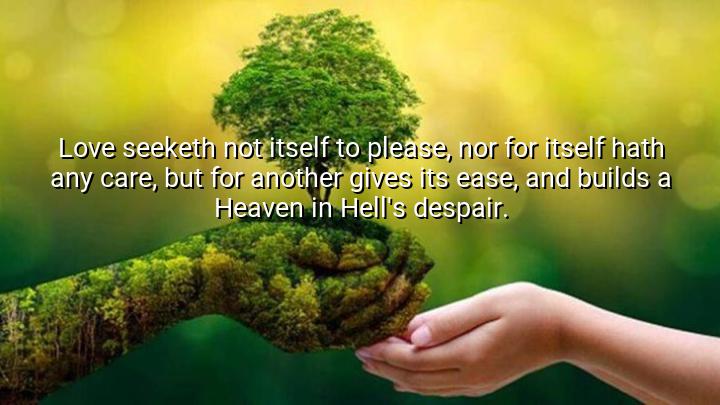




The quote by William Blake, “Love seeketh not itself to please, nor for itself hath any care, but for another gives its ease, and builds a Heaven in Hell's despair,” emphasizes the selfless and redemptive nature of true love. Blake suggests that authentic love is other-centered, focusing on the well-being and happiness of the beloved rather than seeking personal gratification. Love, in this view, is an act of giving and sacrifice, capable of creating joy even in the midst of suffering.
By stating that love “builds a Heaven in Hell’s despair,” Blake highlights love’s transformative and healing power. Even in the darkest or most painful circumstances, love can create light, hope, and comfort. This reflects the idea that love is not just an emotion but a force that can transcend adversity and bring spiritual or emotional redemption.
The origin of this quote lies in Blake’s work as an 18th- and 19th-century English poet, painter, and visionary, particularly in his collection The Proverbs of Hell from The Marriage of Heaven and Hell. Blake’s writings often explore the interplay of spiritual, moral, and emotional truths, emphasizing the power of imagination, love, and compassion to overcome human suffering and societal constraints.
Overall, the quote illustrates Blake’s belief that love is selfless, redemptive, and transformative. By portraying love as a force that seeks the good of others and brings light into despair, he conveys that the essence of love lies in its ability to give, heal, and elevate life, demonstrating its profound moral and spiritual significance.

AAdministratorAdministrator
Welcome, honored guests. Please leave a comment, we will respond soon