

Love possesses not nor will it be possessed, for love is sufficient unto love.
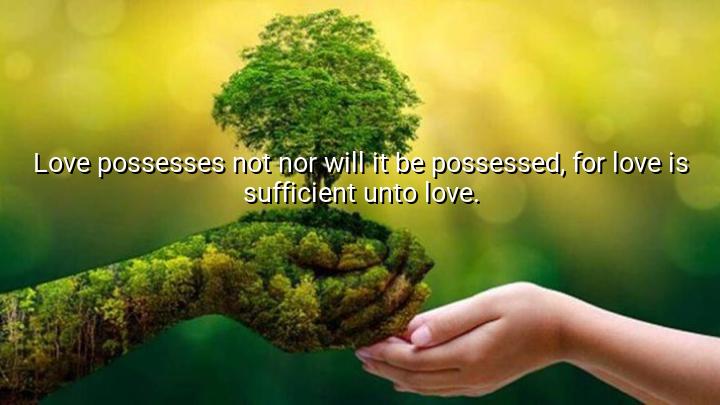




The quote by Khalil Gibran, “Love possesses not nor will it be possessed, for love is sufficient unto love,” speaks to the self-sufficiency and freedom inherent in true love. Gibran suggests that love is not about ownership or control, but rather about mutual respect and autonomy. In a healthy relationship, love does not seek to possess the other person, nor does it allow itself to be confined by expectations. Instead, it is a force that exists freely, nourishes itself, and is complete in its own right.
Khalil Gibran was a Lebanese-American poet, philosopher, and artist, best known for his book The Prophet, which explores themes of human existence, love, and spirituality. Gibran’s writing often emphasizes the importance of balance, freedom, and self-expression in relationships. This quote reflects his belief in the transcendent nature of love, which does not need to be possessed or controlled to be meaningful or fulfilling.
The meaning of the quote underscores that love is a force that does not need to be bound by possessiveness or insecurity. True love flourishes when both people are free to be their authentic selves, and it is not dependent on ownership or control. Gibran suggests that love is sufficient unto itself, meaning that it does not require external validation or attachment to be valid or powerful. It exists in its purest form when it is allowed to grow freely and without restraint.
Ultimately, Gibran’s words offer a profound insight into the nature of love: it is an elevated force that transcends physical boundaries and possessions. By understanding that love is not something to be owned but something that is freely shared and nourished, we can experience its most authentic and fulfilling form. This quote serves as a reminder to appreciate the freedom and independence that true love brings, and to let go of the desire to possess or control it.
Would you like a simplified version of this idea for easier reflection or sharing?

AAdministratorAdministrator
Welcome, honored guests. Please leave a comment, we will respond soon