

Love means to love that which is unlovable; or it is no virtue at all.
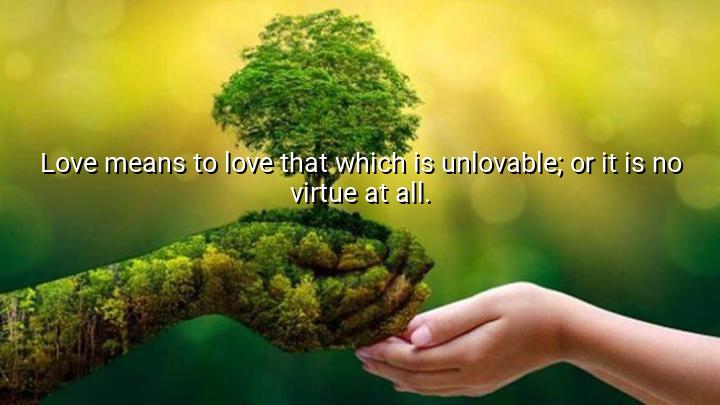




The quote, "Love means to love that which is unlovable; or it is no virtue at all," by Gilbert K. Chesterton, emphasizes the moral and transformative power of love. Chesterton suggests that true love is not limited to those who are easy to love or who meet our expectations. Instead, it requires patience, compassion, and acceptance toward the flawed, difficult, or even unworthy. Genuine love is a virtue precisely because it transcends convenience and self-interest.
The origin of this quote comes from Gilbert K. Chesterton, an English writer, philosopher, and theologian of the early 20th century, known for his witty yet profound reflections on ethics, society, and human nature. Chesterton often explored the paradoxes of morality and faith, highlighting that true virtue manifests in challenging circumstances. By linking love to virtue, he presents love as an active, deliberate practice, rather than merely an emotional or sentimental experience.
On a deeper level, the quote illustrates that love is transformative. Loving what seems unlovable fosters growth, empathy, and understanding, both in the one who loves and in the one who is loved. It challenges individuals to rise above superficial judgments and to embrace a higher, more unconditional standard of care, revealing the depth and resilience of authentic love.
Ultimately, "Love means to love that which is unlovable; or it is no virtue at all" serves as a timeless reminder that love is a moral and ethical force. Chesterton’s words encourage us to practice forgiving, patient, and selfless love, showing that true virtue lies in extending love where it is hardest to give, transforming both the giver and the recipient in profound ways.
I can also create a short, punchy version suitable for a quote card or social media post if you want.

AAdministratorAdministrator
Welcome, honored guests. Please leave a comment, we will respond soon