

Let every man and woman count himself immortal. Let him catch the revelation of Jesus in his resurrection. Let him say not merely, 'Christ is risen,' but 'I shall rise.'
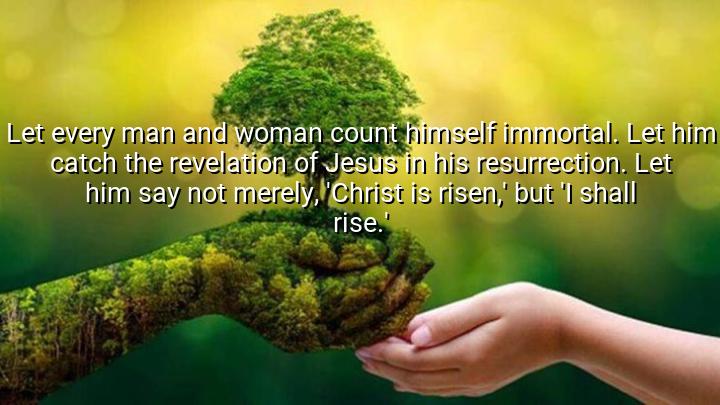




The quote by Phillips Brooks, "Let every man and woman count himself immortal. Let him catch the revelation of Jesus in his resurrection. Let him say not merely, 'Christ is risen,' but 'I shall rise,'" emphasizes the personal and transformative power of the resurrection of Jesus Christ. Brooks encourages individuals to internalize the promise of eternal life and spiritual renewal, making the resurrection not just a historical event, but a personal source of hope and strength.
The meaning of the quote lies in its call for faith and self-realization. Brooks invites believers to move beyond passive acknowledgment of Christ’s resurrection to actively embrace its implications for their own lives. By saying "I shall rise," each person recognizes their own potential for spiritual growth, eternal life, and triumph over suffering and death, connecting the universal message of Easter to individual experience.
The origin of this quote comes from Phillips Brooks, a 19th-century American Episcopal clergyman and preacher, known for his powerful sermons and writings on Christian life. Brooks often emphasized practical faith and moral inspiration, aiming to make the teachings of Christianity tangible and personally meaningful. His words reflect his commitment to linking theological concepts with the lived experiences of ordinary believers.
Ultimately, Brooks’ quote encourages an active, personal engagement with faith. It transforms the Easter message from a communal celebration into a declaration of individual hope, urging believers to see themselves as participants in the resurrection and as heirs to the promise of immortality. This perspective highlights the intimate and empowering nature of Christian belief in eternal life.

AAdministratorAdministrator
Welcome, honored guests. Please leave a comment, we will respond soon