

I've told my children that when I die, to release balloons in the sky to celebrate that I graduated. For me, death is a graduation.
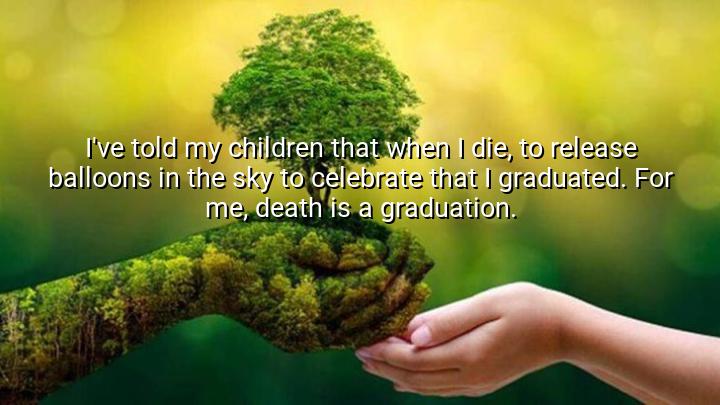




The quote by Elisabeth Kubler-Ross presents a deeply philosophical view of death. By equating death with a graduation, she suggests that death is not an end but a transition to something new, similar to how graduation marks the end of one phase of life and the beginning of another. Kubler-Ross imagines that after her death, her children will celebrate her life and accomplishments in a positive, celebratory way, symbolized by the release of balloons into the sky, as a gesture of joy rather than sorrow.
Kubler-Ross is widely known for her work on the stages of grief, particularly through her book On Death and Dying. In this quote, she reinterprets death not as a tragedy, but as an inevitable, natural transition that deserves recognition and celebration. By framing death as a graduation, she encourages a perspective shift—viewing death as a meaningful part of the human experience, one that signifies growth and the completion of a journey rather than its abrupt end.
The origin of this quote stems from Kubler-Ross’s career as a psychiatrist and author, where she spent much of her life studying and helping people cope with the emotional and psychological aspects of dying. Her experiences working with terminally ill patients and their families deeply influenced her views on death and the importance of approaching it with understanding and acceptance. The idea of graduation as a metaphor for death reflects her belief that the process of dying can be a moment of transformation and peace.
Ultimately, Kubler-Ross’s words challenge conventional views of death, encouraging people to see it as a natural progression. Her perspective offers a way of dealing with death that emphasizes acceptance, celebration, and closure, and invites others to view the end of life as a transition into something beyond, rather than as a finality.

AAdministratorAdministrator
Welcome, honored guests. Please leave a comment, we will respond soon