

I've never made a penny being a doctor, so that makes it not a job. My sense of a doctor is that one is a presence caring for health. So I'm never not a doctor. People call me from all over the world who are hurting, and I care for them. Chatting is what more people want than anything.
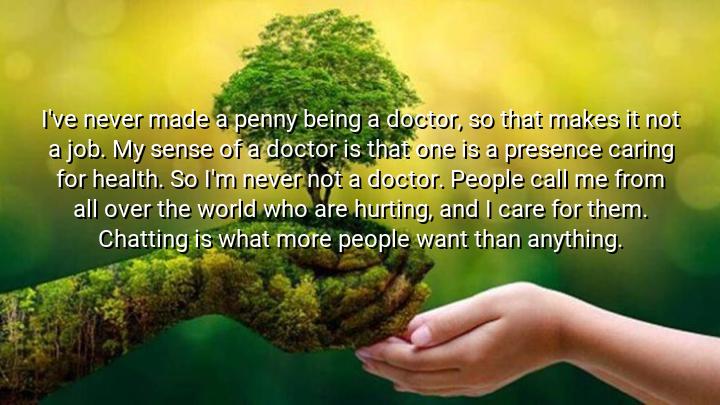




Patch Adams’ quote emphasizes his belief that being a doctor is not just a profession or job, but a calling that transcends financial compensation. He explains that he has never made any money from practicing medicine, which, in his view, removes the notion of it being a conventional job. Instead, he sees being a doctor as a continuous responsibility to care for health and provide comfort, no matter the situation. For Adams, medicine is about being a constant presence of support and care, not just treating patients for financial gain.
Adams also highlights that he is "never not a doctor," meaning that his role as a healer extends beyond traditional work hours or settings. Whether or not he is formally working in a clinic, he continues to engage with people who are in need of help. This statement emphasizes the idea that being a doctor is more about empathy, compassion, and ongoing care than the clinical aspects of the job. His sense of being a doctor involves an emotional and spiritual commitment to the well-being of others.
The quote also touches on the significance of chatting or having meaningful conversations with patients, which Adams sees as a form of care. He recognizes that sometimes people seek more than just physical treatment—they need someone to listen to their concerns and offer emotional support. By saying that more people want chatting than anything, Adams is acknowledging that human connection is a powerful form of healing that goes beyond medical procedures.
Patch Adams, known for his unconventional approach to medicine and health care, founded the Gesundheit! Institute, a medical facility focused on providing care with compassion, humor, and human connection. This quote reflects his philosophy that medicine should address not just physical ailments but also the emotional and psychological well-being of patients. It illustrates his belief in the deeper, more human aspects of healing, which is why he continues to be seen as a pioneer in holistic care.

AAdministratorAdministrator
Welcome, honored guests. Please leave a comment, we will respond soon