

It's simply untrue that religion provides the only framework for a universal morality.
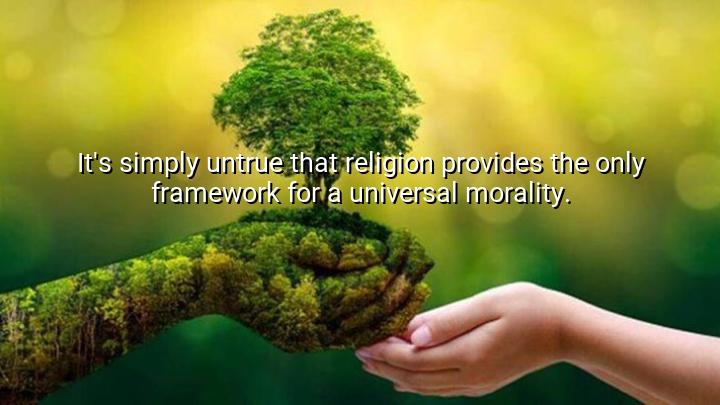




The quote by Sam Harris challenges the common belief that religion is the sole source of moral guidance. Harris argues that universal morality—principles of right and wrong that apply to all humans—can exist independently of religious frameworks. The quote emphasizes that ethical behavior, compassion, and justice do not require adherence to specific faith traditions and can be grounded in reason, empathy, and human experience.
The origin of this insight comes from Harris’s work as a philosopher, neuroscientist, and author, particularly in his writings on ethics and secularism. He frequently explores the idea that morality can be understood scientifically and rationally, without reliance on religious dogma. Harris’s perspective is part of a broader critique of the notion that faith is necessary for ethical conduct, advocating instead for a rational approach to moral questions.
At its core, the quote conveys that ethical principles can be universal and accessible to all, regardless of religious belief. Harris emphasizes that humans are capable of developing moral reasoning through understanding the consequences of actions, empathy, and a commitment to reducing suffering. This perspective broadens the scope of morality beyond religious boundaries, suggesting that a secular framework can also guide ethical decision-making.
Ultimately, Sam Harris’s words encourage reflection on the sources of morality and the role of reason in ethical life. By asserting that religion is not the only path to universal morality, he highlights the potential for human beings to cultivate ethics, fairness, and compassion independently, creating a society guided by thoughtful and inclusive moral principles.

AAdministratorAdministrator
Welcome, honored guests. Please leave a comment, we will respond soon