

It's obvious nonsense, but it makes nice people feel good about themselves to do their bit for the planet. It's vanity of a grotesque kind to believe that mankind, and our 'carbon footprint', has more impact on the future of Earth than Nature, which bends our planet to its will, as it sees fit.
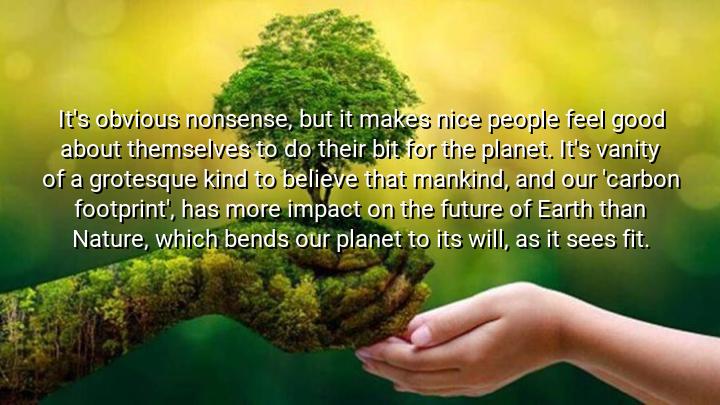




Charles Saatchi’s quote critiques the concept of humanity’s impact on the environment, specifically the idea that our "carbon footprint" plays a significant role in the future of the Earth. He describes the belief in the power of individual actions, like reducing carbon emissions, as "obvious nonsense"—a way for people to feel better about themselves without making meaningful change. Saatchi argues that this belief is a form of vanity, as he contends that the forces of Nature, not humans, are the true drivers of the planet’s future. Nature, according to him, has the ultimate power to shape the Earth as it sees fit, regardless of human efforts.
The origin of this quote comes from Saatchi’s outspoken and often controversial opinions on various topics, including environmentalism. Known for being a renowned British art collector and advertising mogul, Saatchi’s views are often provocative and challenge conventional wisdom. His statement reflects his skepticism about the environmentalist movement and the growing emphasis on individual responsibility for combating climate change. Saatchi believes that, while human actions are important, the larger forces of Nature—such as climate cycles, natural disasters, and evolutionary processes—have far more power over the fate of the planet.
Saatchi’s reference to "vanity of a grotesque kind" suggests that humans may be deluding themselves into thinking that their actions—like reducing their carbon footprint—can significantly alter the future of the planet. He contrasts this belief with the vast and uncontrollable forces of Nature, which have shaped Earth for billions of years, long before human civilization existed. In Saatchi’s view, the belief in human dominance over environmental change is not only misguided but also an example of self-importance and hubris.
Ultimately, Saatchi’s quote challenges the notion of human exceptionalism and questions the effectiveness of individual actions in the face of global environmental issues. His statement calls for a more humble perspective on humanity's place in the natural world, urging people to recognize the limitations of their power in influencing the broader environmental forces that govern the Earth.

AAdministratorAdministrator
Welcome, honored guests. Please leave a comment, we will respond soon